It was, I'm told, a very good book that I noped out of about ten pages in.
I made it that far before becoming incredibly annoyed at the way literature critics were praising his new invention of post-apocalyptic stories which nobody had ever read before ever.
Also, if I remember correctly, he felt that the rules of punctuation didn't apply to him. Maybe that paid off if I'd read more than ten pages.
I don't doubt that he was a true giant. But even setting aside these purely meta-textual gripes, it's just not a story I want to hear. If I want to be depressed and angry, I'll read Hacker News.
Don't blame him for being praised by critics, I don't believe he's the one who claimed to have invented post-apocalyptic fiction.
I get the punctuation issue, but I think his writing is proof that you don't always need to follow the rules from elementary school. He was so meticulous that, even without commas, all his sentences remained clear, and the effect it had was—for most readers anyway—to make the meaning somehow clearer, and certainly more powerful.
Honestly, I should have led with the last thing. The real reason I didn't want to read it is that it was violent and unpleasant. There are many people who find value in such things. I'm not among them.
I haven't read it myself, but I've seen many report that it was uplifting to them. Amid the utter horror and hopeless bleakness a parent does everything they can to protect their child.
> I haven't read it myself, but I've seen many report that it was uplifting to them.
Uplifting? There was nothing uplifting about The Road. It's a world without hope. From the description of the forests, seas, societies and families, cormac builds a truly hopeless apocalypse with no hope for redemption or salvation. A world where hope cannot exist.
> Amid the utter horror and hopeless bleakness a parent does everything they can to protect their child.
A father tries to do everything he can to save his son, but ultimately, he fails. It's a world without hope after all. The father dies and a bunch of cannibals "take in" the boy.
It's one of the rare books that I finished in one sitting and then read again a few days later.
> But the love between the father and his son persists to the very end.
So what? Of course the love between a father and son persists. It's only natural. But that's not the point of the book. The book is about finding hope. The father is desperately trying to save his son. To find hope for his son. He thinks there is hope along the coast. That's why they are on "the road". When they reach the coast, they find a leaden sea holding no life. All marine life is dead. They find no hope. There, cannibals that were hunting the father and son shoot the father with an arrow and the father dies. The son buries his father and the cannibals find the boy and "take him in".
This is just reviews with the word "uplifting". Many of the comments with "uplifting" is just saying it is not uplifting.
"This is an unusual book. There is nothing uplifting here, so don't expect it."
"As uplifting as a charred word void of virtually all-living species. As uplifting as a dead land shrouded in night, blanketed with ash and gray snow, legions of charcoaled corpses ornamenting the highways and hallways. As uplifting as the vicious gangs who prowl the countryside surviving on the last food source - other humans. As uplifting as the Halocaust, Idi Amin's Uganda, or Pol Pot's Cambodia."
Read the book. There is nothing uplifting about it. The only thing uplifting about it is that we don't live in such a world. It's as hopeless a world as you can possibly create. It's a world where the wife and mother of the protagonists goes off into the woods to kill herself rather than face the horrors that await her and her husband and her son. That's how bleak and hopeless the world is. It's a world where the father carries a gun to take out his son and himself in case the cannibals get them. It's a world where the father fails to keep his promise to his son and dies, leaving him to a pack of cannibals. And that isn't even the worst of it. What exactly is uplifting here?
> I have read the book, and it is about sticking to your morals no matter how evil the world will become.
What morals? They stole other peoples stuff. They abandoned the poor people in the basement to die at the hands of the cannibals. They "helped" the guy they met on the road but that was due to childish naivety of the son. It was superficial and meaningless help. The book was entirely about amoral animalistic survival than morality. Notice how it was mostly the son who wanted to be "moral". If anything, the book is saying being moral is childish in an amoral world.
If anything, it showed the inability to stick morals. The most important "moral" of the story was the father's promise to the son and his wife, not to let the son fall into the hands of the cannibals. Throughout the book the father promises to kill them both if it came to that. In the end, the father couldn't bring himself to kill the son and left him to the cannibals who were hunting him.
In your response, you say we don't know whether the "good guys" got him or the "bad guys" did. It's obvious the "bad guys" got him. On your first reading, it isn't clear, but after subsequent readings, it is obvious there are no good guys left and the cannibals who were hunting ( or possibly other cannibals ) them got him.
> That is the message of the book.
If that was the message, the book showed how stupid and pointless it was. Not that it was a good thing. If there was a "message", it was that the mother was right and the father was wrong. But that isn't the message either.
Rather than taking the book for it is, people are trying to find a positive message to make themselves feel better. That's a childish notion. Not everything is a disney movie. Not everything has to have a happy ending or a positive message. You don't have to be uplifted or find morality in a book.
It is not. The man that found the child had a shotgun. He was trying to convince the kid that he had his own wife and child. If he was one of the cannibals, he could have just shot him and got it over with...this is like a six year old we are talking about. Overpowering him, kidnapping him, or just shooting him would be more easy. It doesn't make sense for him to try and convince the kid to join him.
>If anything, the book is saying being moral is childish in an amoral world.
I highly disagree. the man had problems trusting others, for good reason. But the child was a reminder to him WHY it is important to stay good. It ties in with Plato's concept of Eudemonia. Helping others must come with a sense of self-preservation. To save others with abandon is not moral...it is recklessness. On the other side of the coin, having nothing BUT self preservation is cowardess. They represent both sides of the same coin...the boy tugs at the fathers heartstrings to keep him in touch with his morality, and the father has the common sense to keep them alive.
>Rather than taking the book for it is, people are trying to find a positive message to make themselves feel better. That's a childish notion.
Making your interpretation the "one and only interpretation" and dismissing others as "making themselves feel better" is closed minded, myopic, and also childish. While I disagree with your interpretation of the book, I respect it. However the point of art is to attach personal meaning to it. That is not childish...that is human.
Your interpretation is that there is no meaning, and that morality is pointless. Mine is that it is important to do your best in a world that is evil, even if you mess up and don't live up to your own standards sometimes. "carrying the fire" seems like obvious symbolism to me for morality. They don't always carry it...they are sometimes bad themselves. When that happens, the kid gets upset at the dad and there are consequences. The dad develops as a character and decides that giving up and killing them both is the wrong thing to do. Is he right? Honestly probably not. But that is the thing about morality, it is not always black and white.
> If he was one of the cannibals, he could have just shot him and got it over with
In the book, the cannibals like to keep their "herd" alive in the basement. Remember? Why did they keep their humans alive?
> Overpowering him, kidnapping him, or just shooting him would be more easy.
No. It would be easier to convince him to follow them willingly. Would you rather drag a corpse 10 miles or have the the corpse follow you 10 miles. I can't tell if you are trolling or not? Throughout book, exhaustion and the physical toll play a prominent role - of just pushing a cart, father carrying the boy, etc.
It's getting exhausting repeating the obvious. The conclusion of the book is the father dead and the orphaned boy ending up with cannibals. Exactly what they wanted to avoid and breaking the promise that the father made to his wife. If that is uplifting to you and you find moral value in that fine. I guess if you keep looking for something, you'll eventually find it. Even if it is not there.
My problem with your reasoning is that it relies on a literal interpretation of the words spoken in the book. The father says that "there are no other kids his age", yes, but remember...most of the book is told through the father's eyes. He doesn't know any more than we do. There is no information technology anymore...all he knows is that he has not seen any kids and that he hasn't heard of any kids. He is an unreliable narrator.
>No. It would be easier to convince him to follow them willingly. Would you rather drag a corpse 10 miles or have the the corpse follow you 10 miles. I can't tell if you are trolling or not?
I am not trolling. Have you ever picked up a six year old? They weigh practically nothing. The cannibals are not shown to be as exhausted or weak as the father so it would not be as much of a problem. Perhaps if he gets off to the idea of betrayal, or if he really does think that having a kid follow him for 10 miles would be easier convincing him would be easier, but I have a hard time believing that.
>I guess if you keep looking for something, you'll eventually find it. Even if it is not there.
I could say the same thing about your interpretation of events. I do wish you would be more open minded and less cynical...the way you so easily dismiss people and feel that your interpretation is the only correct one is extremely offputting. Productive conversation cannot happen if you keep dismissing everyone else as "missing the obvious."
> My problem with your reasoning is that it relies on a literal interpretation of the words spoken in the book.
What? Now you are just desperately grasping at straws.
> The father says that "there are no other kids his age", yes, but remember...most of the book is told through the father's eyes.
And? So what? The kid also says so, not that it matters.
> There is no information technology anymore...
That's right. Before the internet and IT, nobody saw any children. This comment is the dumbest thing I've read in a long while.
> all he knows is that he has not seen any kids and that he hasn't heard of any kids. He is an unreliable narrator.
The kid also said so. And I don't think you know what "unreliable narrator" is. There has to be clues within the story to imply that he is unreliable ( psychologically, memorywise, etc ). Not that he doesn't have access to a smartphone.
> Have you ever picked up a six year old? They weigh practically nothing.
Yes. Not only that, I was six year old once. Long before I was 6 years old, my parents stopped carrying me around. And you are being intentionally sneaky here. Who said anything about picking up a 6 year old. I said carry a 6 year old how many miles they had to go.
> Perhaps if he gets off to the idea of betrayal, or if he really does think that having a kid follow him for 10 miles would be easier convincing him would be easier, but I have a hard time believing that.
Yes. It's easier to believe that in a starving world, a random kind couple is willing to take in someone else's child to feed. Something his own father struggled immensely to do. That is easier to believe.
It's obvious what happened. It's why you ignored every one of my points except the absolutely nonsense about "no more information technology..."
Let me guess, you are the type of person who watched the movie No Country for Old Men and believe that chigurh didn't kill the wife. Or that the girl in the red dress in schindler's list wasn't dead but playing dead because she was saved by some magical good nazis. At this point I hope you at pretending to be trolling to save yourself some embarrassment.
I'm so dumb. I forgot that before information technology, kids were invisible. Thank you.
It is not letting me reply to your reply to my comment, so I am going to reply here instead.
>What? Now you are just desperately grasping at straws.
Explain. Am I incorrect?
>And? So what? The kid also says so, not that it matters.
Because he has not seen any. Just because they didn't see any kids doesn't mean they don't exist. The fact that the kid himself exists suggests that this is not entirely correct.
>That's right. Before the internet and IT, nobody saw any children. This comment is the dumbest thing I've read in a long while.
I would appreciate it if you could make a point without resorting to insults. For one suggesting that others are childish for their interpretations, you are resorting to childish actions.
As for my point, perhaps I was not clear in my meaning. I meant that there was no way to verify that there are no kids...no newspapers saying that "all kids are dead," or any other way for him to verify that information. He is just saying what he has seen, which is no kids.
>There has to be clues within the story to imply that he is unreliable ( psychologically, memorywise, etc ). Not that he doesn't have access to a smartphone.
Again, you misinterpret my point. The father is not omniscient. He does not know for certain.
>Yes. Not only that, I as six year old once. Long before I was 6 years old, my parents stopped carrying me around. And you are being intentionally sneaky here. Who said anything about picking up a 6 year old. I said carry a 6 year old how many miles they had to go.
At this point, I am starting to think you are not actually reading my comments. A well fed cannibal with a stomach full of people is not going to have trouble carrying a six year old the same way a starving father on the brink of death would be.
>Let me guess, you are the type of person who watched the movie No Country for Old Men and believe that chigurh didn't kill the wife. Or that the girl in the red dress in schindler's list wasn't dead but playing dead because she was saved by some magical good nazis. At this point I hope you at pretend to be trolling to save yourself some embarrassment.
Now you are resorting to ad hominem and assuming things about my character. No, I am sure Chigurh killed the wife. I have not seen Shindler's List so I cannot say one way or the other.
>At this point I hope you at pretend to be trolling to save yourself some embarrassment
The only person embarrassed here is you. You have shown great immaturity during this conversation, and immediately assume the worst in everyone. That says a lot more about you than me. I will not be continuing this conversation, because it is obvious any further discussion with you will be fruitless. Have a blessed day.
From what I recall, it's not stated that the family who takes in the boy are cannibals. That could be one interpretation, I suppose, if depression is your goal.
But if you take them at their word, they're "carrying the fire", so the story gets a hopeful ending.
Perhaps that's what people find uplifting about it.
>This is just reviews with the word "uplifting". Many of the comments with "uplifting" is just saying it is not uplifting.
I noted that when I posted the link. But at least half are saying it is uplifting.
I obviously can't argue further as I haven't read it. I will remark that different people will react to the same material variously uplifted or beaten-down, and neither reaction is less valid (unless they just misunderstood the plot). Personally, I tend to find depictions of nobility and perseverance in the face of imminent doom interesting and moving if not uplifting.
> I obviously can't argue further as I haven't read it.
You should. It's the best of its kind in my opinion.
> I will remark that different people will react to the same material variously uplifted or beaten-down, and neither reaction is less valid (unless they just misunderstood the plot).
I'm open to people having subjective feelings - like whether they enjoyed it, they found it too graphic, not graphic enough, etc. But uplifting is different. There has to be something concrete to back up the feeling of being uplifted.
> Personally, I tend to find depictions of nobility and perseverance in the face of imminent doom interesting and moving if not uplifting.
But that's the point. It isn't nobility and perseverance in the face of imminent doom. The mother thought it was inevitable doom. The father had hope. It's perseverance in false hope. Nonexistent hope. It's like you seeing a person jump 100 stories from the twin towers and flapping his arms in the hopes of flying and saving himself. Would you say that is uplifting? Of course not. Unless you were being edgy or silly.
Instead of reading silly amazon reviews, go read the book and see for yourself.
> It felt to me that the family that takes in the boy are not bad people.
What family? You really believe the man and woman who took in the boy had a "family"? A world where boy's own mother abandoned him and his father to kill herself because there was no hope. A world where there are no plants, animals, fish, etc left. A world where a a woman gives birth and then she and her friends cook the fetus over a campfire. You think in a world where there is no food, no possibility of food, where everyone is either starving to death or cannibalizing, that there is a happy family? It's a world where everyone is starving to death. You think "a family" is going to take in an extra mouth to feed?
Did you miss the parts in the book where they explicitly mention how there is no children the boy's age left? The boy desperately wants a friend but there are no children his age left. Except for that one "imaginary" kid he ran into that disappeared. Why do you think that is?
Also, the father and son were being hunted by a pack of cannibals who mortally wound the father. What are the odds that the cannibal hunters caught up to him. What are the odds that a magical good samaritan family stumbled upon him?
When I first read the book, I thought the kid was saved. Then I reread it and boy cormac really made it crystal clear how hopeless that world was.
> The boy offers to give the man his pistol but the man tells him to keep it. That indicates the man is not trying to trick him.
Yes and the nice cannibal they killed offered to give them food and shelter. Remember how nice that cannibal was? The pistol was worthless and if I remember correctly, it didn't even have a bullet left. Of course he let him keep it. It's no threat.
> Talking about odds in a fictional story is misguided.
No. It's a matter of determining what is most likely.
> The odds are 100% whatever the writer intended.
Yes. The author wrote everything that led up to the meeting for a reason. Everything the author wrote leads to the man and woman being cannibals. It's pretty obvious. It isn't a children's book. For children, the author explains everything clearly and spoonfeeds you. But for adult books you have to think about what the author is trying to say. Did that world seem like it had any good samaritans that you envision. No it did not. For a reason.
What the author intended is 100% obvious. You don't like it because you childishly want a happy ending. Cormac wasn't writing disney books or children books. If you are still confused and you seem to be, go read his other books. You'll understand what kind of writer he was.
>I don't doubt that he was a true giant. But even setting aside these purely meta-textual gripes, it's just not a story I want to hear. If I want to be depressed and angry, I'll read Hacker News.
I completely understand. For me, I see it as a story about clinging to hope despite impossible odds. The theming reminds me of the manga Berserk, but way more grounded in reality and somehow even more depressing. Spoilers:
The main character is dying, and will leave his son to fend for himself when he does. The son doesn't really stand a chance, but it is his responsibility to teach him to "carry the fire." It ends a bit vague...the father dies and the kid refuses to leave the body.
Eventually a man comes by and offers to take care of him. Whether or not he is actually a good guy, or yet another disgusting person, is not really known. But its a glimmer of hope, and that is what is important to the message. As long as there is hope, carry the fire.
> It was, I'm told, a very good book that I noped out of about ten pages in.
That's strange. The book grabs your attention from the get go. It starts strong. Stays strong. Ends strong.
> I made it that far before becoming incredibly annoyed at the way literature critics were praising his new invention of post-apocalyptic stories which nobody had ever read before ever.
This makes absolutely no sense. Were you reading the book and reading reviews at the same time?
> Also, if I remember correctly, he felt that the rules of punctuation didn't apply to him. Maybe that paid off if I'd read more than ten pages.
His punctuation was fine. The book reads well. His words and sentences flow. I found it easily one of the most accessible.
> it's just not a story I want to hear. If I want to be depressed and angry Hacker News.
Ah there it is. People with petty gripes always have an agenda. So your "gripes" above are just because you want don't like apocalytic stories and want to warn people off it? Why not just say so instead of making up silly criticisms? Also, it's a work of fiction. It isn't real. Really nothing to get depressed or angry about. If anything, it should make you happy since we don't like in such a hopeless world. But really, like all great literature, it should make you think.
> His punctuation was fine. The book reads well. His words and sentences flow. I found it easily one of the most accessible.
No, this is a fair criticism.
It's true this is done for literary effect, but it does make it harder to read.
To quote McCarthy himself:
> James Joyce is a good model for punctuation. He keeps it to an absolute minimum. There’s no reason to blot the page up with weird little marks. I mean, if you write properly you shouldn’t have to punctuate.[1]
Whilst this might be true, his punctuation style is non-conventional and that does break our expectations making it harder to follow.
> It's true this is done for literary effect, but it does make it harder to read.
What literary effect? I didn't even notice there were punctuation issues until I read the guy's comment. Maybe since it was basically a book where most of the dialogue is between two people? It was one of the easiest and most straightforward reads of my life.
> > James Joyce is a good model for punctuation. He keeps it to an absolute minimum. There’s no reason to blot the page up with weird little marks. I mean, if you write properly you shouldn’t have to punctuate.[1]
...“to make it easier, not to make it harder” to decipher his prose. He wrote that way to make it easier to read. And I agree with him. His prose just flowed. Also, the problem with joyce isn't the punctation. Even with proper punctuation, joyce would be difficult.
But if people have issues with it, then so be it. Are there any examples where his punctuation caused issues for readers?
Yup, pretty much. There was this one passage about the man and the boy hiding and watching some guy. Can't quite remember what was going on, he was like struggling or something, gravely wounded, and then he just dropped dead. The way it read...I felt completely empty and dejected after it and put the book down for a couple days.
I read this book when my second son was just born. I cannot recommend reading a book so bleak and soul crushing and unforgiving as The Road while your mind is at its softest and most protective. To feel so hopeless and inadequate as a father…I would not wish it on even the foulest villain in the world.
Damn. I must have exceptionally dark taste in media, because I've definitely got a few "well, that was good, but I kinda wish I hadn't read/watched it" things in my history, and The Road wasn't even close to qualifying. I'd say the film Threads hit me harder, to pick something with similar setting and circumstances, though that's still not quite in that category.
(It Comes at Night is probably my #1 in that category for film, and I guess Watts' Blindsight in books—both messed me up for days after, the former with some depressive nihilism, the latter with days of fairly intense derealization that weren't too fun—and I'm not normally especially prone to either of those, I don't think)
Blindsight is a masterpiece about intelligence without consciousness. De-linking those ideas can be seriously jarring for humans, because we usually consider them two sides of the same coin.
Plus one of the more normal characters investigating the phenomenon just happens to be a vampire who--surprisingly enough--is neither formulaic nor boring.
> Plus one of the more normal characters investigating the phenomenon just happens to be a vampire who--surprisingly enough--is neither formulaic nor boring.
The writing-guide-esque "OK, now write down ten wild elements or characters that certainly do not fit in your world... flip page ... and now add one of them, finding a way to connect it to some other element you've already established" was almost comically transparent, but also so damn effective that I've added it to the ol' toolbox.
(I mean, I don't know that Watts literally did that sort of exercise, exactly, and even doubt that he did, but in my head that's definitely how that part got in there)
I feel pretty certain that the vampires were included in quite the opposite way - especially if you read the sequel, which features their story more heavily. To me, the existence of vampires in the Blindsight setting seems essential.
I found Echopraxia a disappointing follow-up to Blindsight, because the thematic core was much harder to grok, and it felt diffuse and attenuated. It's very hard to write a novel that explores what it means for scientists to encounter the limits of scientific rationality as we understand it.
Interestingly, (and apropos) McCarthy's last, Stella Maris, I think, did a much more eloquent job of exploring the same themes. Stella Maris is astounding, it's cosmic horror without the 'supernatural.' Instead there's only Gödel and Metzinger.
My impression is that Watts is best at first books in a series. Both Blindsight and Starfish were (and are) absolutely incredible to me, but both of their sequels fall short of the original promise. However, from reading his blog, this is not unexpected. He doesn't write sequels to further explore the same ideas, but to move background ideas into the forefront and explore those. This would naturally lead to disappointment if the reader wants more of the original premise.
That said, I think Echopraxia is a better sequel than Maelstrom and a pretty good book on its own. He is working on a final book in the Blindopraxia trilogy and I expect it to move even further from the wonder of the original book, but now that my expectations are set I am looking forward to it all the same.
I know this won't apply to everyone, but Blindsight is one of the few pieces of media that noticeably changed my life. Here be profound ideas, although your mileage may vary, especially if you're neurotypical or already very well read in concepts of truly alien intelligence. (The space probe chapter was one of the most life-changing passages I've ever read, so that may tell the reader something about my autism.)
I read the entire thing in HTML on my phone on the author's web site over a week or so. After the first few days of catching bits during breaks, I found myself sitting at home on the porch just reading from my phone - not typical for me. (I did later buy a copy.)
It Comes at Night didn't have anything come at night. It was derivative of everything else in the genre to the point of being a snore. I was so disappointed. One of my least favorite A24 films.
I suppose I was expecting peak Shyamalan, but A24.
Yeah, it was mostly just a slow-burn misery-fest. Now that I think about it, I'm not sure I'd put it in the "good, but also horrible" category, exactly. Like, I don't think there's actually much to it other than the misery. Not like a Funny Games, say, that's thoroughly miserable but also doing some other, interesting things that both justify and require the misery.
I like that you can play through both The Last of Us games and think "What a grim existence, scraping together things to cobble a defence against relentless threats. Horrific."
And compare it to The Road, whose environment would have you begging for a holiday to The Last of Us. Not just the lack of food, but the lack of ability to grow new food, to rest, to warm, to heal. The constant, dogged, thinking, scheming threats. And your kid isn't pushing ladders down to you nearly enough.
I've only watched the movie. But after having watched it, I facetiously recommend that you only watch it if you are currently happy. Because damn, is it just the biggest fucking downer. It will make you more depressed after having watched it. So if you watch it while already depressed, I can't imagine the depths it will bring you to.
It's a good movie, and I'm sure a good book (consider it thrown on the backlog), but damn, so effectively bleak.
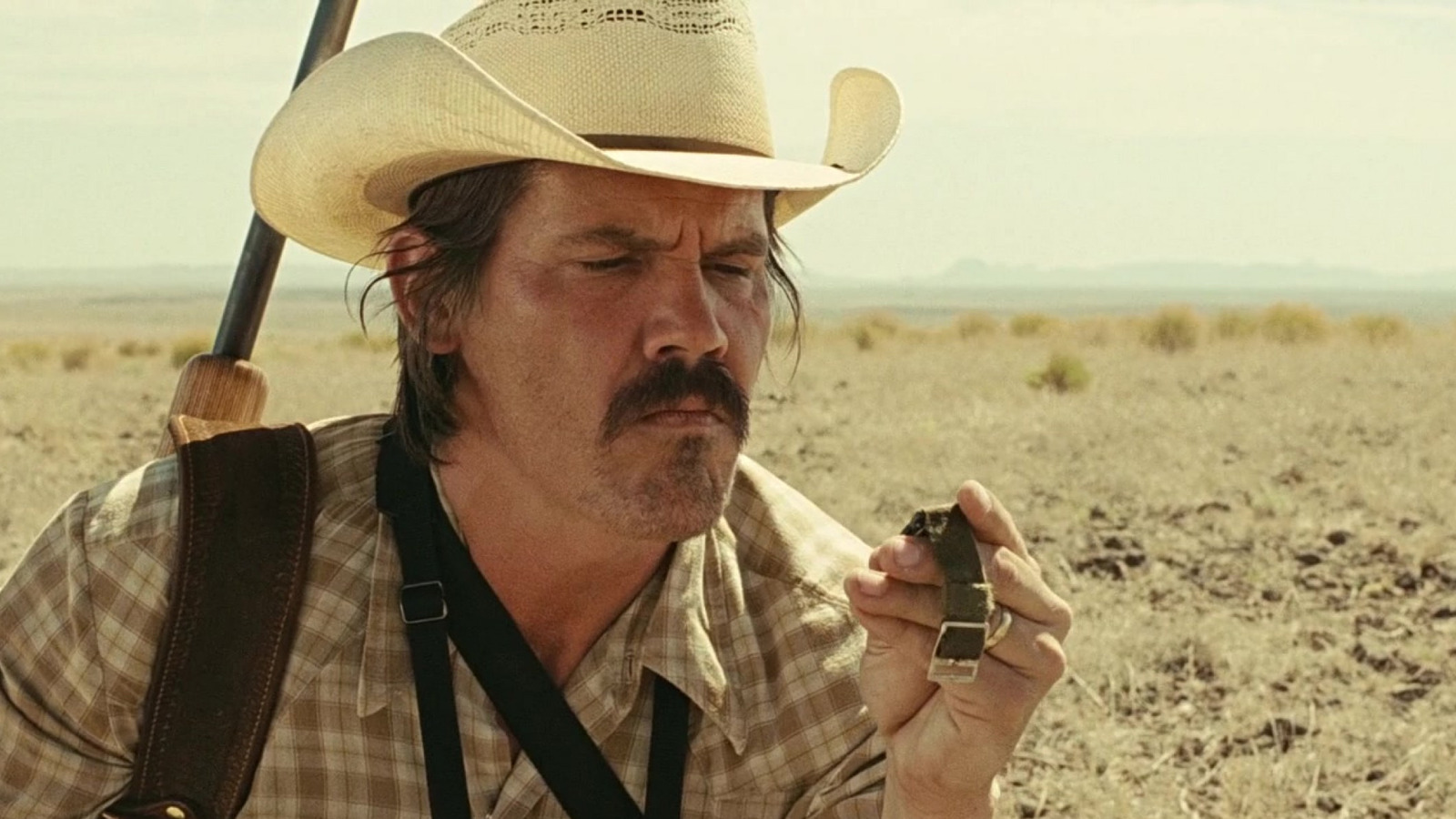
Interestingly Josh Brolin in No Country for Old Men looks alot like Cormac McCarthy around the same age. [1][2][3]
Coen brothers still make movies with real people and brought this world to life in an authentic way.
[Anton vs the "We can't give out no information" lady](https://www.youtube.com/watch?v=_WLA81q9ok0) I love Coen movies with regular people like this. The lady is hilarious and it is one of the only people that Anton didn't take out.
I've watched that one too. That one has a sort of resigned feeling to it. Situations are over, but nothing is really resolved. It's kind of like a serious version of Burn After Reading. Here are these various lives and stories and the situation that has intertwined them. Once the situation is has passed, everyone is affected in different ways, but nothing really ends.
I'd read it multiple times previously, but recently picked it up after having not read a book in a year or two. Got through 160 pages without realising. Felt like I'd blinked and it happened.
My son is now a bit older than the boy would be. I feel like the book would either build your resolve or beat it down, so just go in forewarned.
I did the same, read it in one (or maybe two) days.
In retrospect, I'm conflicted. In some way, it seems too straightforward ("The Road" title fits well) dystopia. Distilled, masterfully executed, but somehow ... trivial? Maybe it's the "Seinfeld is unfunny" trope where it can become obvious only after experiencing it.
I also read The Road in a single sitting but over night. It was also a stormy night in late November which just added to the atmosphere of the book. The next day felt pretty bleak and grey, just like the weather and my mood. I love it when a book can do that to you.
I worked part-time in desktop support at Sitterson Hall, home of the UNC Computer Science program, when I was an undergrad in the late 90s / early 2000s. My team supported Windows, hardware, printers, etc. I distinctly remember closing help tickets for Prof Brooks (and Matt Cutts while he was a PhD student).
My fellow undergrad tech support doofuses and I knew that Prof Brooks was a god and thus walked on eggshells when we were around him...which we quickly learned was totally unnecessary. He was incredibly friendly, gracious, and encouraging. A true Tar Heel.
As a UNC Computer Science graduate, I also had the opportunity to interact with Dr. Brooks on numerous occasions. He was truly a delight to be around and a casual observer would never guess that he was in fact an intellectual giant.
Had no idea till now, three days late. How surreal is the modern web that I find out about this via SV-funded HN, rather than organically in the town that I am currently in, coming from a meeting on the campus of which I just met to discuss plans for future of health computing, from my own campus student newspaper where I worked and where I first heard of and met Fred Brooks.
Professor Brooks is really a pillar of the computer science field, and as you point out, a true Tar Heel. He contributed so much to the students, faculty, and staff at UNC.
I have nothing to say but good things about the guy. He lent me his copy of the Mythical Man Month when I was in high school. (I went to the same church as he did)
The tower in Dallas, NC (on the map) is less than a mile from my childhood home. It sits in the middle of a cow pasture -- I grew up catching bluegill and catfish in a cow pond a few hundred yards from the tower. Never realized that it would be the 4th tallest building in the world if it were a skyscraper. Thanks for sharing.
UNC grad here. These "paper" classes were very well known when I was an undergrad.
Your university almost certainly had similar classes that were very easy and required very little attendance...and were always full of athletes and lazy seniors looking to pump up their GPA.
You can't fault the students (athletes or otherwise) for finding a shortcut in the system and then exploiting it. It is the university's responsibility to quality control its curriculum.
Agree 100%. And -- even if they took "real" classes, all the high profile athletes have private tutors, too, who may well do a large portion of their work for them.
I didn't look closely, but if this product builds a direct-method cash flow statement from a balance sheet - then you've got a winner. Quickbooks - the default small business accounting product - does a HORRIBLE job with the cash flow statement.
Once WiseCash becomes profitable, I plan to work on automating data extraction from various tools (like QuickBooks, FreshBooks etc most likely), either as a first time setup or a full sync process.
I think WiseCash will complement those tools nicely.
Photos taken by you maybe not, but the number of photos taken by your community about your brand is an interesting analytics to monitor. As for like received it as several use: #1 you get to know which photo taken by one of your fan got the most likes and maybe reward this person for his great work. #2 On your own account it's still a great way to see if the content you are pushing to your fans is relevant to them or not.


.jpg)