> We know they watch more television and do less childcare than working-class women, and are less likely than more affluent men to work long hours.
I love the implied slur against working class men not working 'long hours' or doing their share of the childcare.
You can only write a sentence like that if you've never been physically tired from exertion after doing a days work. There simply isn't any more energy to do anything. And putting in 'more hours' is going to be counterproductive since you're expected to perform another act at 6 am the next morning.
I know quite a few of these 'working class men' and none of them seem to live all that long past the age of 65, their bodies a shell of what they were when they started working. And with the recent increase of the age at which the pension system kicks in it's become more common that they don't reach the pensionable age at all.
I think you're being unfair. The author is a sociologist. She's not criticizing working men's behavior. On the contrary - she's simply using it as an indicator to point out that there's something unique about how recent societal changes are impacting this group.
Working class doesn't mean that the work itself is more physical: the majority of these jobs have been taken over by automation and/or transferred abroad. A recent study in the US shows that mortality in white males has increased since the Great Recession. Not because jobs have gotten more physical, but because permanent joblessness has increased. It's increasingly difficult for men - especially those without the economic and employment flexibility that many of us enjoy - to find meaning in their lives according to the traditional roles under which they were raised. Long term maybe this turns out for the best as gender roles ultimately become less pronounced. But it's a hard transition and right this is a real issue that impacts everyone. Just look at current US politics.
> The author is a sociologist. She's not criticizing working men's behavior.
It's not particularly necessary for the article. It reads more like elite signaling- "watches more TV," "does not contribute to housework," are there to remind you that you shouldn't feel empathy, that the subject is low status and low value.
I agree with your sentiment, but I think the author would as well. I'd argue he's not saying that working-class men are failing anyone, rather that being a working-class man is becoming a mentally and morally exhausting pursuit, as well as a physically exhausting one. I'm not old enough or well-read enough to know if the halcyon days when this wasn't the case are actually disappearing, or if they were always a myth (as perhaps the last paragraph implies), but the author seems to be arguing that these men are suffering on a much deeper level than society gives them credit for.
>these men are suffering on a much deeper level than society gives them credit for
As a man I don't want society to give me credit for suffering. I also don't want pity or empathy. Help? Maybe, but only if you let me pay it back.
What I want is to be allowed to solve my own problems. And then a chance to contribute to society. All this while not denouncing my manhood. I'm pretty sure most men feel the same deep down.
>I'm pretty sure most men feel the same deep down.
No, actually. If I wear my body down so much that I'm dying of work-inflicted wear-and-tear, I damn well do want society's empathy and help. "Manhood" and "self-glorifying martyrdom" are not synonyms.
One's ordinary contribution to society shouldn't be cast-from-hitpoints, especially not when it will get you an unremembered early grave. This is the year 2015, not D-Day.
Not actually true! Human adaptation has accelerated in the last 50,000 years, recording more changes than in the previous million. Adapting to crowded cities, monotonous diets, close socialization, rote work has marked our genetics in profound ways.
Owing is one of the bases of all relationships. You are free to say that you do not wish to be owed anything, but that does not actually free society from its obligations to you, nor you from your obligations to it.
The author is a woman. Which seems typical these days with regards to articles talking about men. Or maybe it's just that more sociologists are women (?).
Wonder no more. The American Sociological Association reports data from the National Science Foundation in the U.S. showing over 20 consecutive years of enrollment skewed about 2:1 in favor of women [1].
BTW, this is a hell of an article. It describes an "intransigent masculinity," yet women are not supposed to let men define their femininity?
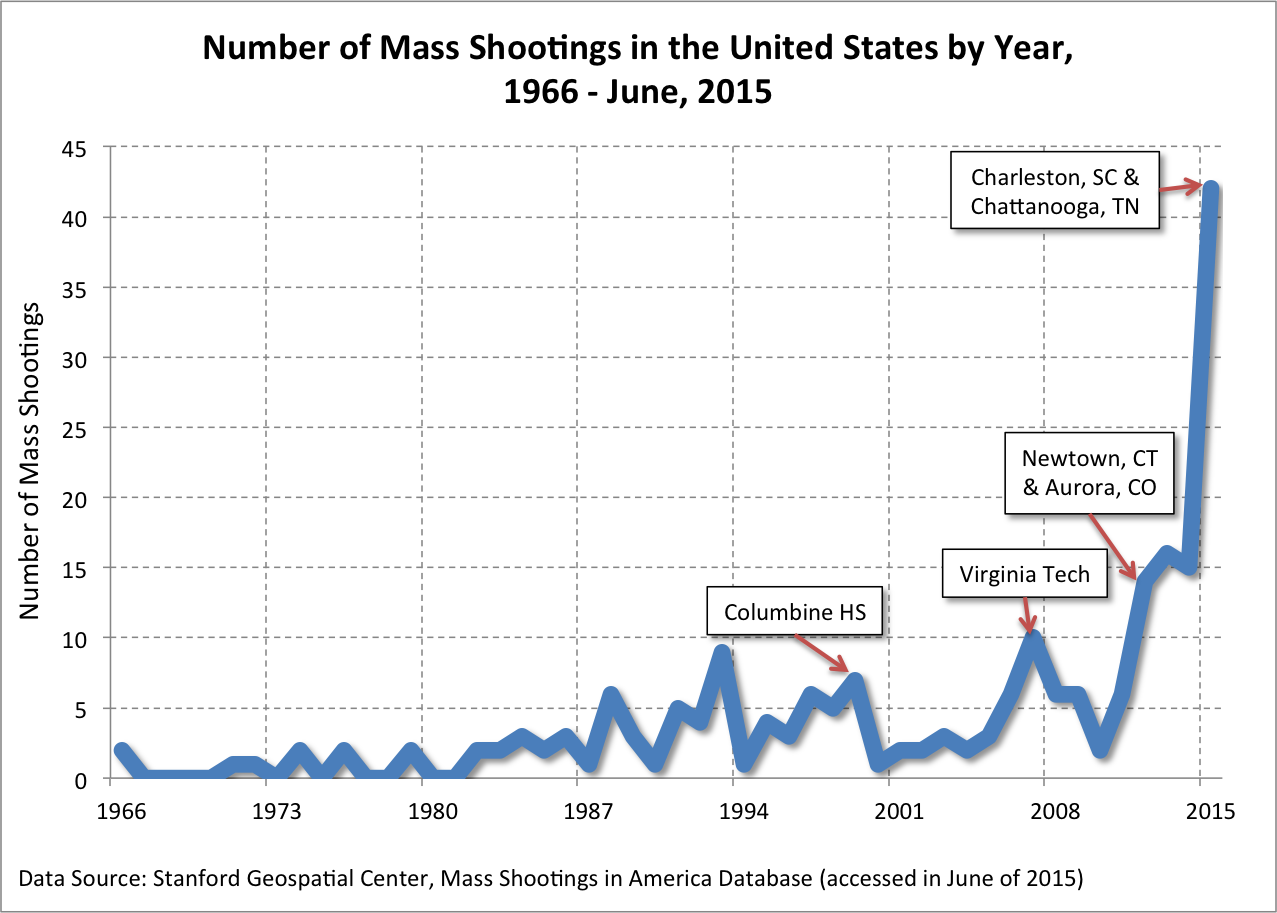
And it blames mass shootings on "masculinity." But take a look at this hocky-stick graph of the frequency of the history of mass-shootings in the U.S. [2]. There's something more than "masculinity" going on here:
Completely anecdotal but I intentionally took a number of sociology courses (despite majoring in a vastly different field) and this was my impression as well. While many of the 101 and low-level courses were closer to 50/50 higher level courses seemed to have a larger and larger majority women.
So it would make sense that more sociology-styled articles are indeed written by women.
Do you know if there was some correspondence with seniority and teaching higher or lower level courses? One way or the other.
It seems to be that some things that are female dominated at lower levels, like undergraduate studies, might still be either more gender balanced or male dominated at higher levels, like research. Whether that is due to a glass ceiling or whatever else, I don't know; you'd have to ask a sociologist about that.
This was the case for me, during my UG and PG studies in psychology.
90% female undergraduate (approx 36 girls, 4 guys including me).
Around 80% female postgraduate.
About 75% male lecturer/senior lecturer/professor.
One of our lecturers brought it up, and I suggested that it might be due to more guys doing psychology in the past, but he refuted this, saying that the gender skew had been like that since he started in the field.
My only real explanation for this is unconscious/institutional sexism.
The discussion is around gender, the gender of the author does actually make a difference in how the article is received (as it should).
People get stupid around gender. If this were an article about christian and muslims, no one would blink at using the religion of the author to help decipher intent.
Because pure objectivity in social sciences is a myth, a utopic state at the best of times? We all have biases when it comes to deciphering human behaviour -- the best scientists will try to shed them harder than others, but they'll likely still retain some.
On top of that, you have to consider that social sciences (including economics) are "Schrodinger objects": as you observe and describe them, they change. Once you understand that, you can leverage the dynamic for personal or political gain, which is extremely common.
As other people have said, the author is not criticising them herself.
However, I think your statement is strange. Firstly, she states that "working class" generally means "without college degree" - that doesn't mean physical work. Secondly, knowledge workers also get diminishing returns from longer hours, potentially with even more dramatic effect. Thirdly, many common non-physical working conditions are also extremely tiring mentally and damaging physically in the long-run. Finally, you're implying that child-care is not physically exhausting.
My impression of your response is that it has more slurs than the article, to be honest - just re-inforcing the primacy of manual labour. I have the impression you know what it's like to work long hours in a stressful non-physical environment, so I find that odd.
> Firstly, she states that "working class" generally means "without college degree" - that doesn't mean physical work.
No, but it in general greatly increases the likelihood.
> Secondly, knowledge workers also get diminishing returns from longer hours, potentially with even more dramatic effect.
To their bodies? Or to the work they do?
Because that's the difference, your body only takes that much abuse and then needs to re-charge. Go work a jackhammer for a couple of hours and let's talk about diminishing returns.
> Thirdly, many common non-physical working conditions are also extremely tiring mentally and damaging physically in the long-run.
Sure. Let's talk after you've been hauling garbage for a day, been bent over under an engine hood or any other physically taxing workday. There is nothing that quite compares to being able to sit in a chair and think all day long and push a few buttons to wreck your ligaments, muscles and joints.
> Finally, you're implying that child-care is not physically exhausting.
I think you made that up, I did not imply that at all. As a father of 3 I'm more than aware of how physically exhausting child care is.
> My impression of your response is that it has more slurs than the article, to be honest - just re-inforcing the primacy of manual labour. I have the impression you know what it's like to work long hours in a stressful non-physical environment, so I find that odd.
An my impression of your response is that you would like all of the above to be true, however and for the record: I've done both. I've had a number of very physically intensive jobs when I started my career and to this day I'm grateful every bloody day that my life took a turn for the better and that I don't have to work until I can't stand up straight anymore. Being not the most physically strong person I realize that if I had continued down that path I would have been a physical wreck by now.
Have some respect for the people that do the heavy lifting. And if you're unconvinced: go take a manual labor job for a year or so and re-read your comment here.
> for the record: I've done both. I've had a number of very physically intensive jobs when I started my career and to this day I'm grateful every bloody day that my life took a turn for the better and that I don't have to work until I can't stand up straight anymore. Being not the most physically strong person I realize that if I had continued down that path I would have been a physical wreck by now.
> Have some respect for the people that do the heavy lifting. And if you're unconvinced: go take a manual labor job for a year or so and re-read your comment here.
Jacques, why the rancor and assumption that the OP and other commenters (like the GP) haven't also had physical jobs? I certainly have… It's all I did the first several years of my working life. And like you, my life is now quite different.
You have a different point of view, but it's not because we haven't done physical work. In fact, in my case I'd say it was my experience doing that kind of work that leads me to identify with what the OP describes in the linked article.
> why the rancor and assumption that the OP and other commenters (like the GP) haven't also had physical jobs?
I'll be happy to accept evidence to the contrary, but by the looks of it the OP has not.
> I certainly have…
Good, so you'll appreciate my viewpoint a bit more than those of us who happen to have lucked out and have been desk jockeys since the start of our professional lives.
> It's all I did the first several years of my life. And like you, my life is now quite different.
My assumption is that because of having had a period in your life where you worked really hard for relatively very little pay that you appreciate what you have today a lot more than you would otherwise.
> You have a different point of view, but it's not because we haven't done physical work. In fact, in my case I'd say it was my experience doing that kind of work that leads me to identify with what the OP describes in the linked article.
I subscribe to some parts of what the article relates to but I take exception with certain parts and the casual way in which 'men without a college degree' (which the lady writing the article is not on both counts) are being labeled as implied slackers because 'We know they watch more television and do less childcare than working-class women, and are less likely than more affluent men to work long hours'.
I've done both. I found manual labour hard but overall easier hours by a big margin. I have physical issues from the non-physical work and I know people who've had (true) burn-out and stress-related illness. My personal experience is that I can keep going physically when I'm exhausted but productivity drops to near zero when mentally tired. My experience is that people massively underestimate the toll of non-physical work rather than that they underestimate physical work.
I'm not understanding the level of emotion. Sorry if your friends & relatives are suffering from their jobs.
> I found manual labour hard but overall easier hours by a big margin.
The toll adds up if you do manual labor long enough. Bodies are machines and they wear out.
> I have physical issues from the non-physical work and I know people who've had (true) burn-out and stress-related illness.
Been there, done that. And these can be serious issues as well, but it's not the same as dropping dead 2 days after you finally receive your pension because your body is done with living.
> My personal experience is that I can keep going physically when I'm exhausted but productivity drops to near zero when mentally tired.
I think we all can relate to that. Which is why we - as a rule in the industry - estimate that people are productive in knowledge work for 4 to 6 hours per day.
> My experience is that people massively underestimate the toll of non-physical work rather than that they underestimate physical work.
My experience is the opposite, people find it very easy to relate to things they have personal experience with and find it hard to relate to things that happen to others.
> Sorry if your friends & relatives are suffering from their jobs.
so, responding only to the office work vs. manual labor work, I come at it from a different angle.
I had a (very little bit) of warehouse work as a teenager. I mean, real warehouse work where you get minimum wage for picking things up and putting them down again, assembling shelves, picking up stuff, etc.. - and I was exhausted at the end of those days in ways that I never am now, even when I do work that is physically more demanding, and I'm in my mid 30s with a body that isn't nearly as resilient as when I was 16.
I've done a lot of data center work that had similar physical challenges, often greater physical challenges; have you ever tried to rack a c6509? bastards are heavy. In fact, I've gone out of my way, and probably taken some pay cuts so that I still get to spend significant time picking things up, putting things down, and turning screws. I enjoy it in ways that I didn't enjoy that warehouse job.
The thing I want to point out here is that doing physically demanding labor while you are in a position to get paid a whole lot of money, like I am, is very different from doing physically demanding labor when you are getting paid very little, simply because respect, flexibility and the ability to ask for changes and exceptions scales with the rest of your compensation.
As a sysadmin, if I need a break? I take a break. Nobody gives me a hard time. There's no grope and grab at the door to make sure I didn't steal anything. If I want a tool or something to make my job easier, really all I've gotta do is find a link and send it to the boss and it gets ordered for me. If lifting something the standard way doesn't work for me? the boss gets someone to help me. My judgment on "yeah, I need a second pair of hands" is never questioned.
I mean, yeah, there are legal protections for minimum wage workers, and workers comp laws incent employers to make sure that they don't screw up employees too badly; but power differentials matter; As a sysadmin, while I'm not going to say I'm irreplaceable, if I walk, the boss will be noticeably inconvenienced. I get a pretty good say in how my job is done.
I imagine the same thing goes for being an independent electrician, or being a mechanic with your own shop vs. being a level one person in either one of those roles. Having the power to make exceptions in how you work, I think, makes a huge impact on how good or bad that work is for you.
I wonder if white collar work is the same way; if you are some minimum wage call center monkey with zero choice in the ergonomics of your workstation setup, is that way worse than being a programmer who can get a $400 keyboard and $6000 chair by just asking? My guess is yes, but I have even less time in the callcenter than I have in the warehouse.
I moved furniture as a young man, and that was only in 8 hours stints at the longest. At the end of the day, my body seemed to rebel against me if I even slightly exerted myself.
My current 60+ work weeks are mainly spent sitting, and although I'm tired at the end of the day, it's nowhere near as taxing as moving furniture was (and I'm older).
>The grief and antagonism that erupt after every school shooting focus on either a prevailing gun culture or mental health problems, but masculinity is surely an indispensable component.
You say you do school shooting and 4chan will tell you "Do it faggot". If you actually do it 4chan will scream "ABSOLUTE MADMAN!".
Male violence happens probably partially because of testosterone. But cultural factors is significant too. Nobody questions your masculinity after such horrid act, probably out of respect to the victims. It seems somehow disgraceful to be killed by a boy. But that denial probably perpetuates the problem.
You can often hear from women something like "You can't have your manhood enforced by violence or job. Be better human instead." But that's not how identities work. Either you find a way to be a man or accept not being a man. The latter is whole new can of worms.
Transgender people suffer from whopping rates of suicide, depression, loneliness and generally feeling insecure. It's unfair comparison. But it's not really surprising, that men with less of same identity problems are showing similar symptoms to lesser extent.
>some scholars think that, just like the black church seems to do for black men, unions could remind more white working-class men to prize not just ‘hard work’ but also solidarity and other values.
Here in Nordic countries unions have lately turned into relatively feminine thing. So this is kind of reformulating the idea "be more feminine". Which is exactly what most men are trying to avoid in the first place.
Theoretically some kind of men-only workers union might be cool. But such "patriarchal" constructs are quite demonized these days.
> Male violence happens probably partially because of testosterone. But cultural factors is significant too. Nobody questions your masculinity after such horrid act, probably out of respect to the victims. It seems somehow disgraceful to be killed by a boy.
They don't question your masculinity because it's not applicable. They say that you are evil instead, because it's bad thing to do. Questioning your masculinity happens if you do something effeminate, and gunning down people is not that.
I guess what you're trying to say is that killing people should be considered emasculating. I think it's more damning to be called an evil scum-bag than to be called a "faggot", though.
Masculinity[1] has both positive and negative traits associated with it. We aren't taught to be masculine even in destructive ways. That's also why we don't emasculate people who are masculine in destructive ways -- because it's still masculine, but not in a commendable way. You see the difference? "Masculinity" does not mean, and is not taught to be, synonymous with "good". At least not these days.
Our concepts of what is good and bad, commendable and terrible, is not one-dimensional and solely attributed to things like gender conformance. Calling someone through-and-through evil and despicable is more isolating and condemning than calling them a pansy. You won't appreciably reduce mass shootings by verbally stripping mass murderers of their manhood, rather than just calling them evil. Sorry.
[1] In the sense of traits and actions which are associated more with men.
Killing unarmed people with a firearm should be emasculating. Just like in western flicks.
If you have accepted for some reason that you are evil scumbag, then that's it. Now you choose whether you are man scumbag or boy scumbag. School shooters are usually already somewhat isolated and they usually end up dead. They don't care getting isolated. They seem to care about posthumous fame.
I don't mind if masculine is not good. What I'm trying to say is that seemingly only surefire way to get the status of a man is violence. Inventing some other certain and positive way to get the status of a man would be great. But in the meantime it would seem like a good idea to make the "madman" status less certain.
>You won't appreciably reduce mass shootings by verbally stripping mass murderers of their manhood, rather than just calling them evil. Sorry.
Killing unarmed people is orthogonal to masculinity.
In general, I think more sympathy with these mass murderers, from those not directly affected, would be a better idea than labeling them as "evil".
While I would not make the same decisions, it's important to realize that the refusal to understand a person's POV contributes towards isolation. That's an important component we don't recognize.
Men don't work because that is their "image of masculinity" yadda yadda yadda. They work to put food on the table for their families.
There also is no "morality tale" for what women supposedly owe their husbands. But it hurts to find you are only valued for your money - is that really wrong, misguided, whatever? Are people not allowed to have feelings in relationships? I bet some wives are also hurt when they get older and find they were only valued for their pretty body. (Not saying either fate is inevitable, but it happens).
Low income is the best predictor for divorce, so there really is pressure on men to perform. And contrary to the feminist narrative it is not men who can't cope with their wives outearning them filing for divorce, it is women who tend to file for divorce.
O.K.--Times have changed. Jobs have changed. There's been role reversals in families. (By the way, the guys I knew who stayed at home and raised the kids; did a stellar job.)
Society has changed a lot. Good Blue collar jobs are hard to come by. Even white collar jobs are not what they used to be. It's basically a mess. Consider yourself luckey if you have a job you don't hate?
That said, when certain people become unemployed--they fall to pieces. I know it a blow. I know there's a risk of homeless. I know he might leave you. (If he leaves you, or "makes you pay for being unemployed" you probally picked the wrong mate?)
What I'm trying to say is don't beat yourself up too much. I have seen way to many people define themself's by what they do. "I'm a blah, blah, blah." You are a person first? With a lot of interests? I know it's difficult. The first question out of every Bobble Head is "What do you do?".
I saw my sister pretty much destroy her marriage. She was making a very good living. He was an Actor, and a great father to their boys. Because he wasn't the guy on t.v.--literally, or figuratively she emasculated him to the point he cheated. He married a person who didn't judge him as a success, or failure. He is now happy. His depression went away. I wonder why?
My sister still watches the television fantasy world where the man is a "man". He's a successful something. He the protector. He's the hard working something? Usually he's an Architect, or Doctor on T.V.? (By the way in real life. If you can make a living as an Architect--you are lucky.)
My sister has been through a lot of men, and never found one that had the qualities of her first husband. She now knows she should not have let the media, and the village; determine what's desirable in a mate. She says pushing away her first husband was her biggest regret.
I have no advice. I just see some men/women go to any lengths in order to get "the paper". Yes, a lot of it is hormones, but don't kill yourself trying to be what this society is constantly thrusting upon us. My father was a "working man's hero". He was misserable too. He died way to soon.
There's a fourth option to encourage longer-term employment which this article doesn't mention (and which seems to get little notice in the USA at least) -- worker-owned cooperatives.
Historically, worker-owned cooperatives did get much mention. The ideal of early labor organization was that the workers should own the means of production. This was exactly why early labor disputes were so bloody: the owners of the factories and mills saw the organized labor movement as theft. That is, organized labor was threatening to "steal" what they "built". Yes, the quotes are mine, because my own viewpoint is one of symbiosis.
The biggest problem is not that a worker-owned coop doesn't work. They do. The problem is one of primate social hierarchy. That is, "someone has to be the boss".
Ownership and who is in charge are orthogonal in this regard. Even if everyone has equal shares in a factory, they are going to vote for what's best for the factory and it's going to piss the workers off that have the worst jobs.
It's nasty because everyone is sublimating the frustration of their autonomy. Their accumulated resentment inspires an "I'll get my turn" narrative. Eventually it's up or out. If it's up then their narrative crystalizes around an identity which is responsible for the output of their unit. They go into fearless commander mode. AKA: narcissism. Ownership sees them as obsequiously adaptable. Fuck the details. They have the best people. Trust them. Then they extract the costs from those beneath them. They just have to work 1% harder than their unit. Meanwhile work-ethic is attributed to character and not compensation. Thus, under-compensated workers can be shamed into over-working. This completes the cycle with another wave of narcissists and (d)ejected losers. Ownership promotes this because they've decided that labor is otherwise fundamentally unmotivated. They don't care about the externalities.
I think it's a misconception that worker coops can't have 'the boss'. Most successful ones I've read about delegate day-to-day decisions to an executive committee.
The differences between that and management-owned companies are the political tools all workers have to influence decisions, and the shared social contract which says all owners have a stake in the company's decision making (not all employees have to be owners from day one).
I have some observational experience of the cooperative movement in two European countries (UK and Italy), having lived in areas where such movement was deeply entrenched in collective consciousness.
My experience is that cooperation is nice but it doesn't scale. As soon as you reach a significant size (a few hundred people), hierarchy is established; leadership will then progressively solidify around a specific network of people, which becomes a de-facto separate class; eventually, you end up in a situation that is cooperative in name only, with a traditional managerial class dominating an exploited workforce; in the best case, the organization will share a culture of respecting workers slightly more than regular companies, but that's about it.
Note that I'm not discarding the model entirely, it can work extremely well on a small scale. There are also "hybrid" examples (like the John Lewis Partnership) which seem to better embody the cooperative ethos than "pure" coops at scale.
Mondragon corporation is pretty big. Of course this brings up larger questions of "worker owned cooperatives" based on the Roman Catholic economic theory of distributism versus the 1960s counterculture version of "worker owned cooperatives."
I don't know Mondragon, but from Wikipedia, they don't seem to be particularly different from the large coops I know: the majority of workers in their largest operations today are not owners but regular employees, and there is still large pay disparity (albeit smaller than elsewhere).
so... why is long-term employment at one employer a good thing?
I think this is an important thing to think about, because labor has been fighting for rules to get companies to reduce turnover for a long time, and I'm not sure that is in the interest of laborers as a whole.
I certainly agree that employment is very important (especially under our current economic system... but personally, I think that having a job might be important even when you don't need to fear for your food.) - I think that lowering the unemployment rate is one of the most important things we can do for the happiness and health of our society, certainly as long as we use our current economic system.
but... I don't see why that means you should work at the same place forever. As is common in my industry, I jump around rather a lot; I don't think I've worked at a company I didn't own for more than five years (and five years was about the max I worked full time at my own company, rather than contracting myself out for venture capital)
In fact, I'd argue that greater job mobility gives the worker more power not less... the coercive power of the capitalist boss only exists if you think that after getting fired from this job you can't get another job. I would argue that workers as a whole would be better off at a same total level of unemployment, if changing jobs was easier, not harder.
Thoughtful piece by Allison J Pugh. I think it's important to work to understand all genders, and I feel that if we continue to focus on only certain genders as we attempt to reform our society we will only reproduce the same historical imbalance just with different winners and losers.
Also the web developer in me has to point out that was a very clean and usable site (at least with my ad blocker and ghostery).
I'm sometimes intrigued that working class men have the time and energy to worry about abstract concepts like "what it means to be a man". Things relating to gender sometimes seems like something academics would care more about. Or people with more comfortable jobs and more time on their hands.
But really people from all spheres of life have strong, weak, but at least some opinion about stuff like that. _That_ is even weirder. That we can't just express ourselves how we are, but have to doubt and second-guess things within some identity framework.
It's only a feminist narrative that men worry about "what it means to be a man". Usually men just do the things men have to do. It is not just a fantasy that they have to do them. Simple example: somebody has to earn money for food and rent.
One of the major roles of academics is to put words and define concepts around things that already exist but that lay people do not consciously think about.
The idea of pondering the role of masculinity comes from the feelings and actions men feel and take, it doesn't define them the other way around.
> One of the major roles of academics is to put words and define concepts around things that already exist but that lay people do not consciously think about.
But people _do_ consciously think about it. Most people have conceptions, insecurities, and pride around what it means to be a man and what it means to be a woman. They are not studying things that people express but are unconscious or indifferent towards.
I think they're confronted with the question of "what it means to be a man" when their wife leaves them. Gary in the article is more upset about his wife(s) leaving him than his loss of a job. At that point I think it's natural to wonder if/why you're no longer able to keep a relationship with the opposite sex.
It's not of course that they have spare time. It's that they're forced to spend time on it because society demands continuous performance of gender and rewards highly people who do it well. It's not abstract; it's practical.
Here's some related reading about men, masculinity, and the pathological expressions of masculinity under a neoliberalism that can no longer espouse flagrant male supremacy like the prevailing social ideas of, say, the 50's. Why are men so helplessly adrift in modern society? In particular, why do some men end up committing acts of mass violence as the ultimate expression of a poisonous masculinity that betrays them from the day they are born? The answer may be that modern ideology provides men no alternative self-actualization than to be a successful and very lonely individual competitor.
"Franco 'Bifo' Berardi is an Italian Marxist academic and theorist who has written extensively on the topic. In the introduction to his study of mass murder, Heroes, he says, "I saw the agony of capitalism and dismantling of social civilisation from a very peculiar point of view: crime and suicide". For Berardi, the mass murderer is not an aberration or a monster, but a character directly produced by a system which coerces us all to be constantly productive and competitive."
"I'm curious: if mass murder is a symptom of neoliberalism, which all of us live under, then why are all of these lone killers men?
Yes, it's true. In the beginning of my book I say that I will be talking about young and old, white and black, Christians and Muslims – but only men. I don't think that a single woman has ever committed these kind of acts. Why so? The crucial point in the narrative is our culture of competition.
I know that many women are indeed very competitive, but I believe that competitiveness as a trait is essentially a male problem: first at the sexual level, and then also at an economic level. Feminism, as far as I can see, is essentially about abandoning and overcoming this imposed sense of competitiveness. This is why mass killers are men and only men."
The book Heroes is a chilling read. The forcible casting of men into these toxic roles that provide only insecurity, loneliness and frustration is a form of biopolitics. The man who is convinced he is alone and must fight and struggle against society to be himself is more useful to that society than a man who is rooted in his community, who endeavors towards his self-actulization collectively, in cooperation with his fellow man and woman. A new masculine paradigm may end up looking quite old: A rejection of neoliberal competitive individualism and a rekindling of the communal man.
That is simply nonsense. Mass killers are not "men and only men." It takes barely no Google time at all to find many examples of female mass murderers.
Not many women make it to presidential or CEO levels of power, but those that do hardly have a perfect human rights record, or show a clear preference for "collective self-actualisation, in cooperation with man and woman."
The problem is unlikely to be down to competition. It may be due to stresses/abuses while growing up and/or in adulthood, but it's difficult to find a definitive map of cause and effect.
I'm certainly not a supporter of neoliberalism in any way at all. But I strongly prefer criticisms that aren't factually wrong.
I really don't think s/100%/95% or something thereabouts really changes the thrust of that one comment. The point is that society's definition of man is toxic and damaging to men who fail to meet its impossible standards or cannot be at the top of their local hierarchies.
It does make you wonder, though. If the author makes such a strong incorrect statement about something so easily researched, then what else do they get wrong? If I started out my treatise saying that the sun rises in the west, would that not be a massive caution to anyone reading it that maybe this whole thing is a bunch of nonsense? Sure, it's possible that this is an isolated failure, but how likely is that?
Well I think reading the book and evaluating its arguments and supporting evidence is the only way. I know that's unreasonable to expect in a forum discussion but I think it would be rather harsh to dismiss the book out of hand because of a slip-up in an interview. It's a failure of small degree, really. I've read other sociological works that talk about the skewed gender distribution in acts of mass violence in a similarly categorical way even though there are documented cases of mass violence committed by women. I think the difference between 100% and some slightly smaller proportion does not change the premises enough to invalidate the arguments.
I think toxic masculinity is under-examined and men are disadvantaged about talking about it and recasting their identities without it because, well, a lot of men in these comment trees demonstrate a resistance to entertaining the idea it seems on principle. That principle seems to be, and I have to guess here because it's usually left implicit, is that masculinity is somehow immutable, innate, apolitical and unideological, and I think that's a harmful attitude to take in the interest of society and one's own interest. It makes violence against men at the level of identity and gender unassailable, unexaminable.
But of course some guy in this comment tree found a way to blame it on feminists and women.
> And traditionally women were loath to marry down, for example, whereas for men it was pretty common. I guess to prevent mass shootings, more feminists should marry down instead of complain about male competitiveness (which is 99% driven by women's choices, as mates is part of what men compete over).
I think the reading I suggested is far more constructive than everything else being brought to the table here, really.
My point is not that it invalidates the argument (because I agree, the difference between 100% and 90-whatever% isn't that important here) but simply that it indicates a lack of awareness about the very thing being discussed.
You're right, reading the whole thing is the only way to know for sure. But time and attention are finite resources. We can't actually read everything. When deciding what to read, I tend to lean heavily towards those things that get basic facts right, because they're more likely to be in some way related to reality.
Maybe you have also read that the distribution of men is wider spread out - more rich men, but also more poor men compared to rich women and poor women.
I think the pressure on men in society is simply higher. Women at least have their wombs, men only bring their achievements to the table. And traditionally women were loath to marry down, for example, whereas for men it was pretty common. I guess to prevent mass shootings, more feminists should marry down instead of complain about male competitiveness (which is 99% driven by women's choices, as mates is part of what men compete over).
I also seem to remember reading that the "running amok" thing also used to happen in traditional societies, so assuming it is a symptom of Neoliberalism is probably incorrect. The word "Amok" apparently is derived from a traditional culture: https://en.wikipedia.org/wiki/Running_amok
I think a near-100% share and a categorical 100% of mass murders committed by men are close enough not to discount that particular observation. I think alienation, anger, and entitlement are the key ideas, and men are especially vulnerable to all 3 because the prevailing conceptions of manhood in many societies emphasize individuality, aggression, and hierarchical thinking amongst men.
Granted, they emphasize those things in general. That's the picture of human being painted by neoliberalism. It affects men more. Men don't have something like feminism yet that allows them to resist these narratives and reclaim their male identity.


I love the implied slur against working class men not working 'long hours' or doing their share of the childcare.
You can only write a sentence like that if you've never been physically tired from exertion after doing a days work. There simply isn't any more energy to do anything. And putting in 'more hours' is going to be counterproductive since you're expected to perform another act at 6 am the next morning.
I know quite a few of these 'working class men' and none of them seem to live all that long past the age of 65, their bodies a shell of what they were when they started working. And with the recent increase of the age at which the pension system kicks in it's become more common that they don't reach the pensionable age at all.
Not all work-hours are equally taxing.