Personal opinion based on anecdotal evidence: population mobility has increased career opportunity at the expense of the opportunities afforded to young families through staying close to home. From newborn to age N, local gandparents can be a godsend. In any family's case, which grandparents are nearby may be crucial, but if you came from a nuturing home, moving to a different timezone has definitely negative, high stress consequences in the young home.
Population mobility has decreased over the past decades, the median american lives 18 miles from their mother, and only 20% of Americans live more than a couple hours away from their parents. (NYT Upshot 12/23/15).
Perhaps the fact that 64% of the women were dealing with unemployment suggests a different stressor.
It would also be interesting to know if "voluntary unemployment" was due to a family-toxic work-life balance from employers (ie, not choosing to work because working would mean 100% childcare time which may not be offset by the e.g. minimum wage income).
Neither my wife's parents nor mine are involved in our lives, and I can say it makes a huge difference - our friends whose parents are involved with the grandchildren have it much easier. Being an island is very, very difficult.
The "Monkey Love Experiments" show that social contact (and love) is more important to monkeys than food. We're not so different. Having your parents help out with the kids is amazing.
Humans were never designed to live in isolation. That is why solitary confinement is a punishment. Being removed from family, lacking access to basic psychological needs (belongingness and love) causes depression and sometimes suicide.
A healthy family unit can provide for our needs of connection, esteem and security.
Alternate hypothesis: population mobility is caused by fewer career opportunities overall and clustering of what opportunities exist in urban areas. Move or starve.
That really doesn't contradict what the person you're replying to said. Your comment manages to be both jerky and irrelevant. It ignores the principle dilemma, which is that taking care of children is easier with a broad family support network, and if you don't happen to have one of those near where your job is located it is harder to take care of children.
Parent didn't try to contradict the grant parent, nor they tried to address their "principle dilemma" (sic).
They merely provided an alternate hypothesis on the root cause of population mobility: not an overall increase of career opportunities attracting people away from their hometown, but a scarcity of career opportunities, where mostly jobs clustered in larger cities remain.
Maybe refrain calling other comments "jerky and irrelevant" when you've missed their point, and don't even understand their aim?
As a recent new father having my mother and father in law has been extremely helpful. For my wife and I we made a decision to move from NYC to live in the same city as them to start our family and that decision has made our lives much easier.
I have the same experience. We decided to move closer to my wife's parents house (20 mins drive) and it has been really helpful with kids. When we feel burned out (which does happen often with both of us working), my wife picks up the phone and asks her(her mom works fulltime as well but has fridays off). Even a few hours on a weekend really helps to just be alone without kids.
Moving to within a twenty minute walk of both sets of grandparents is probably the best decision my wife and I have ever made. We spent the first year of having a child several hours away and it was super tough, and pretty isolating. The last couple of years have been so much easier thanks to grandparents meaning we're able to get out for the occasional meal, or drop our son round for a few hours when there are things we need to get done.
Young women are the group who self harm most, but who are at lowest risk for death by suicide.
This appears to be slowly changing. It seems that women are choosing more lethal methods for self harm and attempted suicide, and thus dying more frequently.
There's still a 3:1 male:female ratio. But (at least, in the UK) rates for men are slowly falling and rates for women are slowly rising.
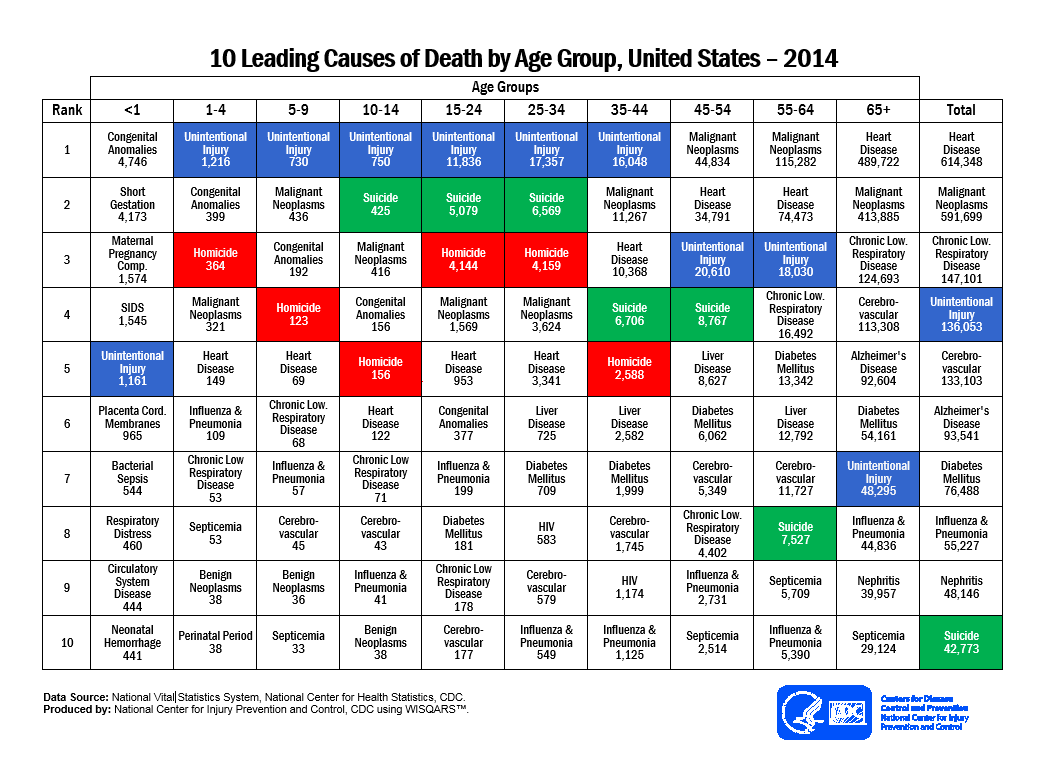
For a group supposedly at low risk of suicide, who also have higher than normal health risk, (and who are at higher risk of domestic violence) it's disturbing that death by suicide is a leading cause of death.
Tackling mental health stigma, especially around the perinatal time, is crucial to save lives. In England there's informal peer support from Twitter @PNDandMe. Watch out - this is informal and there's not much in place around governance or safeguarding. There are other things happening - there are national programmes to improve perinatal access to MH services including tackling the stigma.
The city of Denver alone seems to be going through a major addiction epidemic. As someone who lives in Denver i'm a little surprised that this doesn't get much national coverage, yet it comes up quite often in local publications.
> Overdose deaths from just one kind of opioid painkiller outnumbered all homicides in Colorado in 2015, according to new data from the state’s Health Department.
> In 2015, 259 people died from overdoses of what health officials call “natural” prescription opioids — drugs like hydrocodone and oxycodone. That compares with 205 people who died from homicide.
It doesn't get much national media coverage because it is not exceptional. Nationally, there are about twice as many opioid overdose deaths as homicides. Colorado's rate of opioid overdose deaths is only roughly 20th of the states.
Well yes but the article includes accidental overdose
> “Maternal Deaths from Suicide and Overdose in Colorado, 2004-2012,” found that of 211 maternal deaths, 30 percent were from self-harm, defined as suicide and nonintentional overdose deaths occurring during pregnancy and the first year after giving birth.
But this is a problem of definition. Not including those deaths isn't any more accurate, it just under-counts suicide deaths.
How do we know those were non-intentional? Coroners (for a variety of reasons) are cautious about declaring a death as suicide, and so there will be a number of suicides in the non-intentional overdose deaths.
The article is at least being clear on what it's counting as suicide, and that definition is close to some other well respected sources. For example, the UK's Office for National Statistics used this:
"includes deaths from intentional self-harm (where a coroner has given a suicide conclusion or made it clear in the narrative conclusion that the deceased intended to kill themselves) and events of undetermined intent (mainly deaths where a coroner has given an open conclusion) in people aged 15 and over."
but now uses this:
"The National Statistics definition of suicide includes all deaths from intentional self-harm for persons aged 10 and over, and deaths where the intent was undetermined for those aged 15 and over. This definition was revised in January 2016 and further information on the impact can be found in the 2014 suicide registrations bulletin."
You either under count, or over count, death by suicide. Since suicide is under reported by coroners, and it's a leading cause of preventable death, it makes some sense to over count it. The UK uses different counts for people under 15 because homicide is more likely than suicide in that age group.
Don't have a good answer but I believe drug abuse is on the rise so if drug abuse is rising (and not due to increased desire to self-harm) then this statistic would increase as well, and the phenomena would be conflated.
Given there's so much ink being spilled about the drug abuse increase in America, OPs statement makes sense to me and unless they are separated (again we are talking about under 200 data points) I think it's tough to say self-harm is explicitly on the rise.
Post natal (or post partum if you're USian) depression is a much bigger problem than is generally recognised. Typically it'll occur in 10-15% of mothers, and if there's a history of depression or other mental illness those numbers are much, much higher. Its also reasonably common in fathers, who while they don't have the physical shock to deal with, are dealing with everything else.
Sadly at last in the UK its handled really badly, often with a health visitor just writing it off as "baby blues", and saying it'll pass. In most cases it probably will, but there seems to be pretty minimal training to recognise the cases where more needs to be done. I'm not usually one for this sort of thing, but my wife and I went through this a few years ago after the birth of our son, if you don't know where else to go or what to do my email address is in my profile, feel free to use it.
It's pretty sad that the question "Why are western women, particularly American women, so miserable?" is now a political question. (And therefore resists attempts to discuss it, which I don't recommend btw.)
Of these, points 4 and 5 are easily fixable by making these things free for everyone. Accordingly they have been fixed in basically all other first world countries than the US, and several developing countries as well (like India and South Africa).
This is also reflected in infant mortality rates; of the 35 OECD countries, only Mexico, Chile, Turkey and Slovakia have worse infant mortality rates than the US. For some US states it's even worse, e.g. Alabama is worse than Lebanon, and Mississippi is on par with Botswana.
And these statistics are especially shocking given that it's estimated that Britain (with very low child mortality; 5/1000 live births versus 2/1000 for Finland) is poorer than the poorest state in the US
I believe the British NHS system takes really good care of pregnant women and kids. We lived 6 months in the UK when my wife was expecting our second child, and we got free checkups with the local doctor, free ultrasounds etc., no questions asked, even though we were citizens of another European country and were not paying any taxes in Britain nor were we members of UK social security. (I was being paid in our home country, which is legally OK for short term stays).
The NHS is fantastic at dealing with pregnancy, children, and a "normal" post-pregnancy in mothers.
Sadly its woefully inequipped to deal with postnatal depression, as my wife and I discovered after our son was born. My wife has a history of mental illness, which means the risk of postnatal depression was about 50/50 and everyone was meant to be aware of that. Despite that getting anything done eventually involved turning up at the emergency department and making it abundantly clear that someone was likely to die if nothing was done, we were incredibly fortunate to get one of the few hundred mother and baby unit beds in the country, and even more fortunate that it wasn't far from where my parents live meaning I could actually be involved day to day - in the same unit there were mothers whos partners had to make a 400 mile round trip to see them, because that's where the only free beds were.
The care from the mother and baby unit was fantastic, I just wish the same care was accessible to everyone who needed it, rather than just the very worst cases.
The reason lots of Americans want to repeal Obamacare is because their opinions are formed by listening to demagogues who have the interests of the 1% and of big businesses in mind, while playing the populist card of "lower taxes for everyone".
Healthcare is no different from roads, schools, libraries etc.: everyone pays for other people using it, because otherwise you would have a crappy system. Taxing everyone to provide basic necessary services and infrastructure is the definition of society. Removing those taxes is the same as taking steps back to being uncivilised.
I am not joking when I say the US has one of the most expensive (per capita) healthcare system in the world, while also one of the worst. I mean, really, Cuba scores better on most healthcare metrics! They're not exactly known for being a wealthy people, yet they can somehow all afford better healthcare than the average American. They even sent about twice as many health professionals (in absolute numbers) to aid West Africa during the Ebola crisis than what the US did. Twice as many, from a population less than that of Ohio alone.
Of course it's political. Western culture has moved away from glorifying the nuclear family as the ideal way of living, so generations are being brought thinking that having a family is not all that important.
I believe that a lot of issues like this (with depressed and drugged out single moms, etc) could have been avoided if more people realized that having a tightly knit nuclear family is definitely worth striving for. And that a lot of the cultural changes over the past decades (the promotion of promiscuity and other forms of social liberalism) are not really progressive in terms of improving the quality of life within our society as a whole.
I don't understand this argument. Almost everything worth talking about has a "political" dimension, or it would be solved already. There's costs and tradeoffs, to whom should they be allocated?
"Political" need not be the same as "partisan", although people are trying to make everything partisan these days.
I think a significant portion may be military spouses. It's very difficult for a new mom, even more so if the father is recently deployed and there's no other family close-by.
We probably need to be a bit careful with definitions here. CDC are very precise with their definition of suicide (Something like "death following self injury where the intent was to die"), other orgs use "death following self injury".
Accidental death ("unintentional injury") (motor vehicle incidents, accidental overdose, etc) is the leading cause for young people (20-30s), men and women.
Postpartum hormonal changes require a change in the brain chemistry: Prolactin (https://en.wikipedia.org/wiki/Prolactin) is enabled by Dopamine level going down. Dopamine is a key brain chemical affecting mood and energy to think. The potential for unexpected behavioral changes is a given. If someone is sensitive, already off balance or the change is larger than usual there is a great risk for mother and newborn.