Context is interesting here: uBlock Origin is one of the few extensions available in "Firefox Preview," the new Firefox app for Android. The app is somewhat controversial for breaking existing extensions, but they have been slowly adding some whitelisted extensions, with uBlock having been the first announced.
I hope Mozilla is able to roll out full extension support sooner rather than later in FF Preview, but I do appreciate that they take it seriously enough to work with developers this closely.
I am using FF Preview and in the past few days I have noticed the following extensions available:
uBlock Origin,
HTTPS Everywhere,
Privacy Badger,
NoScript Security Suite,
Dark Reader,
Search by Image.
I suspect there is a level of curation/testing going on here. As a non-release product I can understand the need to allow/test extensions in a controlled manner.
We're working really hard to make extensions a first class product on Firefox Preview. The team rewrote the Android side of things from scratch so there's a lot to rebuild but we're getting close. Stay tuned!
I'm eagerly awaiting getting back an extension that let me strip the tracking tokens from social media sites, along with redirecting away from AMP. You'd think these would be baked into the browser's tracking protection.
That sounds like a bad idea - how would the browser know the tracking token is a tracking token and not just a token? And wouldn't redirecting away from AMP be taking away control from the user?
As extensions those are fine, as core browser features, they sound a bit iffy.
So is downloading amp pages in the background and bloating your phone by default though (chrome). I think something like that should be turned on by default but toggleable. It's a sensible option for a privacy focused browser.
AMP is just an ordinary page on google domain. If you're going to hard-code some anti-Google behaviour in Firefox, it means to start a war against Google. Not the wisest decision when Google is the main revenue source for Firefox AFAIK.
Given Google's reach, not the wisest decision for any browser maker.
Google being the main revenue source for Firefox is often cited and is true, but if you look at Brave, its competition, what they do is to block a publisher's ads, replacing them with their own, being essentially racketeering and I'm surprised how they weren't declared illegal already.
Fact of the matter is, if people don't pay money for browser licenses, and they don't, and if ads don't fund those browsers, and they currently do, then alternatives to Chrome cannot exist, if not funded by another mega corporation that can burn money just so Google can't be the only player, like what Apple does.
---
But back to decision making — we are talking about AMP pages being served by searching on Google.com, because that's the major source of these links.
Given the search engine is Google's property and not some public utility, they can destroy any browser maker if they wanted to.
Speaking of which, if you're so bothered with Google.com serving AMP pages, well, why not choose an alternative instead?
Brave just has adblock by default with an opt-in system for ads based on notifications. It isn't replacing the ads on the page. Not sure how you see that as racketeering, it's a completely different system.
But it does replace the ads on the page, because those ads they serve are related to the pages you visit and that the system is "opt-in" is irrelevant, because that's their business model.
It's racketeering because they piggyback on publishers for serving their ads contextually, while not allowing publishers to run their own ads, forcing publishers to join if they want any revenue from Brave users. Brave wants to be a gate keeper, coercing publishers in the process.
Again, I don't see how this isn't illegal. It's one thing to be a non-profit browser extension developed by a community on GitHub, it's quite another to do build ad blocking products for profit, because the later is clearly copyright infringement at the very least.
Right, forgot about that. It only makes my point stronger though.
Given Google's reach with their search engine, with YouTube, with Gmail, starting a war with Google would be a death sentence for a browser maker, no matter the supposed source of funding, which is basically ads across the board anyway, an industry also controlled by Google and Facebook.
AMP breaks down some fundmental things about the internet. Obviously tracking tokens could be changed over time, but there's a blacklist in the popular Privacy Badger extension. Firefox's privacy protection features have varying levels of opt-in-ness, so I don't see why if pulling in Disconnects blacklist for one thing is okay, but tokens not. I'm fine with an extension too, but right now only one extension is whitelisted for the new Firefox on Android.
Historically extensions have moved faster than the companies.
Also I highly doubt Google will ever change the utm parameter name. There’s thousands of JS libraries that extract it and use it for various additional analytics, hosted blog/wordpress hackery. and e-commerce/payment plugins that inject it across iframes and other stuff.
Plus tons of server side apps that pattern match on utm_ or simply injects them into urls and views.
It’d be a nightmare for tons of businesses which have complicated setups which reuse or inject the token for conversion tracking alone, not including all the other stuff.
Don't think of it that way. Think of it as cookie/token spam. Just like email spam, we'll have to employ various tactics in order to fight back. Heuristics, known bad-player Databases, punishment and domain-blocking, etc. How likely is it that any mail server will deny mails coming from facebook.com? The ability to "send" your browser tokens should be something that requires a reputation that the various entities/domains have to earn and retain. And if Facebook decides to abuse it, then their domain will start breaking because they rely on cookies.
What seems fishy to me is that all the news I hear about Firefox Preview is "this extension will be available" and so forth, when what I should be hearing about is whatever new innovation broke compatibility with existing extensions and what its benefits are.
We started from scratch with the WE implementation in Firefox Preview and are building things incrementally. So it is not that things broke, it is more that a lot of WE APIs are simply not available yet.
The concern is that this is mostly just a play to create a walled garden with curated extensions, and not a technical issue. It's one thing to have this restriction in beta, but will they keep things locked down one they replace the old FF?
My understanding: They are not changing the extension model, Firefox Preview simply doesn't have the full extension API of old Firefox implemented yet. Some people are always ready to assume the worst when it comes to Mozilla and threw a hissy fit over the fact that Mozilla is running an open Beta with Firefox Preview [1] that is only slowly coming up to full extension support, hence the 'controversial'.
To be fair, their initial roadmap early last year had Firefox Preview replacing the current Firefox for Android early this year with 0 extension support. So it's more than "extension support wasn't ready for beta". I wonder if that would have changed without the complaints...
My understanding is that extension support got bumped high in priority after the unrelated extension breakage (due to an expiring certificate) in the old Firefox for Android. When that happened their rating in the Play store positively tanked with people commenting about broken extensions, even though it was fixed fairly shortly.
Fair, initial communication focused around a fast timeline and didn't mention extensions. Given the history that was clearly a mistake. I still think the reaction was a bit hysterical. Mozilla had very good reasons (conveniently ignored by some people) to break the extension ecosystem when they did, and they communicated that reason. In contrast they didn't say anything about not supporting extensions for future Firefox mobile.
It's easy to say that the reaction was hysterical when the change that users wanted was made (well sort of, there's still a whitelist for extensions with no definite end date). But if people just posted on the first HN thread "I don't like this" and left it at that, I bet they would have followed their original roadmap more closely if there was no outcry of the plan to replace the current browser with no extension support.
It's also worth putting into perspective that most of the "hysteria" is people posting their disapproval in HN/Reddit threads or putting thumbs down reactions on github comments. It's not like people were picketing Mozilla HQ.
I'm sure you can find examples of crazy people on Twitter, it's a group of over 100 dissatisified people, but that's certainly not the majority.
Hey I am not saying people weren't perfectly in line to ask about this and raise the point/push for only releasing at feature parity. That's not what I recall the tone was though, heck even in this thread people are claiming that Mozilla wanted to eliminate extensions altogether. Mozilla employees also responded to these HN threads straight away clarifying that extensions were being looked at closely with intent (albeit no commitment) to have feature parity at launch.
As I said, given the history they should have had a clear communication of what they intend to do about extensions when they premiered Firefox Preview. Of course that also implies that they would have had to have a clear idea of what they are going to do about them at the time.
I know, it's a defensive reflex these days. A lot of criticisms of company decisions these days get "Look, there's this person on Twitter/Reddit/whatever saying they wish bad things on an individual at the company", and an attempt to tar all critics as being like these examples. Usually in combination with calling the reaction overblown, which is I guess why I'm very defensive on this thread specifically.
Thank you for the clarification. I found it hard to believe that another iteration of the extension APIs would happen so soon, especially after the last backlash (despite the long warning time) but a brief search didn't throw up anything either way.
Perhaps you forgot to paste the [1] source in your post, but the point was well made.
Fenix is pretty much a complete rewrite of firefox on mobile, and they haven't implemented every extension api yet which is why only a subset of extensions are allowed currently.
I've read that you can sideload any extension you want (although I've not tried this personally), it'll just be coin flip whether it actually works or not.
So developers can now test for Fenix but there's no permanent solution yet, unless there was something else and I just can't for the life of me find it anywhere. Sorry for getting your hopes up!
What's slightly mysterious to me is that through my firefox account it autoinstalled I think at least noscript and cookie autodelete even though they were not at the time in the mobile add-on store. I was surprised and confused to find that javascript wasn't executing by default and discovered that not only did they install but they seemed to be working. I removed them because it seemed accidental and figured they might not be ready, and they were no longer possible to install.
Now I see that several other plugins are on the Firefox Preview add-on list including noscript and some others so I have the feeling that they're just being cautious about enabling them in the store but it's possible that they mostly will just work after a testing period.
I've been using FF preview for the last month or two. I'm not in love with the UI, just like desktop Firefox, it's a bit tacky. But the reason I switched was because it's the only browser that allows mobile extensions and syncs bookmarks with my desktop. I'm waiting eagerly for the "I don't care about cookies" extension, since browsing the internet from my phone has become a chore since GDPR. But even with only a few available extensions, mobile extensions in Firefox are the one thing that has me hanging on to using it as my primary mobile and desktop browser.
When _Preview_ 1.0 shipped in June last year people wrongly assumed that all the things missing were intentional and final and made of course a huge stink about it here and on Reddit.
Reality is much simpler: we have a small team and we want to do all the things, but we simply can't because it is a lot of work. So what you are seeing is incremental updates that get closer and closer to a fantastic product that we hope you will love and use on a daily basis. Great Web Extensions support is part of that. It always was. We just never had working code until recently.
(Disclosure: Engineering Manager of the Fenix 1.0 team)
I just want to say that Firefox Preview is fantastic, and I don't understand why people seemed to decide there was some sort of weird conspiracy to remove extension support. You guys are clearly doing a great job.
Which was the dumbest thing ever, since extension support (read: adblocking) is literally the only thing that can get people to switch over to firefox from chrome
It's definitely a huge factor, and probably the biggest one, but I think it's false to say it's the only one. For example, part of my choice is that I don't want to use a browser whose mission isn't to integrate as tightly as possible to Google.
Maybe I'm wrong, but I've an impression that redesign uses much more screen space. Which is not very good for usability in my opinion, at least for existing users.
FF Previews is a godsend on older phones, and also on newer ones it is nice to have a browser that fast available. Completely different level than the old Firefox on Android, which I already liked.
I've been using Android since 2012 and I only have one phone that doesn't run Android 5 or later, which is the Galaxy Nexus from 2011. That phone famously (and controversially[1]) stopped getting updates after less than 2 years. My other phones, a Moto X (2013), a Moto E (2014), a Blackberry Priv (2015), a Moto E4 (2017), and a Moto G7 Power (2019) are all on 5.0 or later. I know not every manufacturer is as good as Motorola at providing system-level software support but I think supporting phones from ~2014 and later is a good enough baseline these days. The last time Google released Android version stats[2] (about a year ago?! WTF!) they showed devices running 4.4 and below at only 10% of total devices.
I have been using normal Firefox on Android for years. It has full extension support and takes 30 seconds from app launch to being able to load a website. Should I report this bug?
Mainly block css. But, a better way to block media, CSS, scripts, frames in a fine grained domain basis--more complicated in ublock.
Also, limit cookies by domain. Certain websites(extremely rare ones) need 3rd party cookies to function.
The main reason is that I was unaware of this, thank you for pointing this our to me.
I like to block all third-party javascript, because it's often unnecessary, and a useless drain on my battery, memory and privacy. I would do it for first-party js as well, but that breaks a lot more websites.
Funnily, websites that break the most without third-party js are e-commerce ones...
Slightly offtopic: Will there be a way to transfer data (history, settings, cookies ...) from the old mobile Firefox to the new one without syncing it all to "the cloud"?
AFAIK Firefox sync doesn't save anything in "the cloud". It's just synced from/to your other devices. The data is also encrypted using your Firefox account password, much like what cloud-based password managers like Bitwarden do. So I don't think Firefox Sync would be a bad way to get your data transferred.
> I consider the high information density to be a key usability quality for advanced users (which is the purpose of that panel), as it allows to see a lot at a glance
I wish his extensions (like ublock0) had labels alongside each icon. uBlock Origin does show tooltips on hover, but these are slow to appear.
I’m using Firefox Preview (the Nightly version) on my phone. I’ve installed Privacy Badger instead of uBlock Origin because it’s not an ad-blocker. I hope DuckDuckGo Privacy Essentials is added soon.
for me personally adblocker without element picker is pointless, I want to customize sites I visit every day from clutter, only ublock allows that (reason I use Kiwi browser), I wish there were more browsers with built in adblockers which would allow element picking, bit until then my only options are kiwi browser, yandex better and firefox, which all support ublock extension
I had horrible experience with Firefox preview, used it for few weeks but each week there was new bug added, not nothing fixed
If you want extensions in Android mobile browser you can try Yandex (need to first enable through flag and install uncompressed) or Kiwi Browser (last time updated in October but feel free to compile it from source code on github) which can install extensions without jumping through the hoops, they are both better options than buggy Firefox preview.


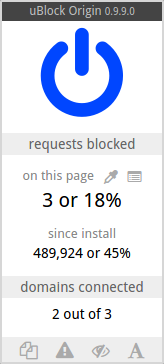
I hope Mozilla is able to roll out full extension support sooner rather than later in FF Preview, but I do appreciate that they take it seriously enough to work with developers this closely.