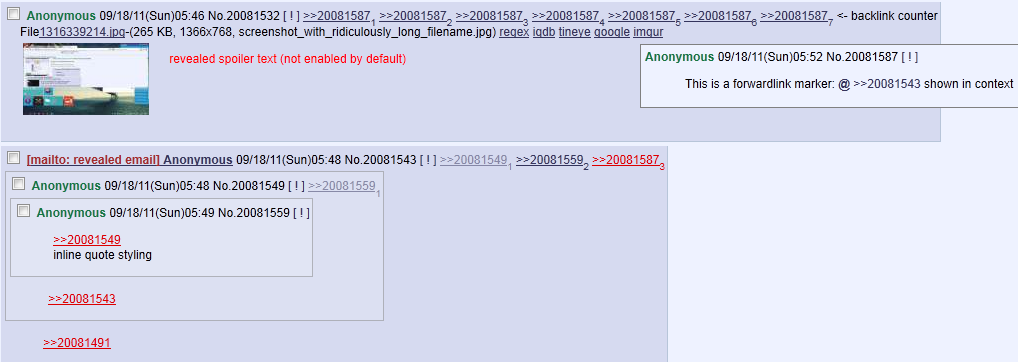
IMO *chan's are still the best way to handle this, especially when you can expand inline. You maintain the linear flow of conversation, and linearity maintains its status in the foreground, but you can optionally expand into other the conversation history through repeated expansion (and following various trees)
Organization like in the TFA just totally fucks up the flow of conversation, and totally ignores the fact that conversation is a graph, not a tree, and you naturally want to hop between conversation topics freely. You want to cross-post.
Not to mention that AFAICT just totally ignores tangents-within-tangents, a perfectly normal model of communication.
The fundamental problem though TFA is solving really is the treatment of persons-involved as defining a conversation, rather than the topic of conversation itself; The article has really just recreated BBS thread topics, with permissions scoped to a group of users.
Multiple conversation threads inside a BBS post means you 'view' the post as a feed, 1st Order comments as Posts, and 2nd oder...
Branches become trees and leaves become branches.
Building a single 'view' to handle shifting perspectives is not easy and OP seems to have at least thought this through with a proposal to have 2 different modes.
I'm looking forward to part_2 and (and maybe comparing it to my own conclusions ;}
That's why I'm suggesting the model is fundamentally wrong -- it shouldn't be represented as a tree (because conversation is a graph), and it shouldn't be represented as a "feed", because its infinitely recursive and a feed is specialized for a single depth.
The best representation is to flatten the graph (to produce a linear set of posts), and dynamically iterate from a post to its parents and children per user input. Inline post expansion ala 4chan[0] is the superior representation, because trying to decide ahead-of-time the best "hierarchy" to represent is the wrong question. The conversation is dynamic, and inter-related, and thus so too must be the UI. Obviously inline doesn't make sense on mobile, due to limited space, but its fundamentally more correct.
It's the same reason twitter conversations beyond a single thread are hard to follow -- you're iterating trees but you're trying to read a graph.
So you made me finally go look closely at a _chan board and I get your points now. TBH I see the greentext screenshots a lot and they usually trigger a dyslexic response. But after playing a bit I totally agree the way they allow for rollover views of parent and grand parents while keeping the conversation flat & chronological is effective. Cross posting a comment to multiple parents totally breaks the tree/branch/leaf logic but I can see how useful it is tying similar tangents together and riffing feedback off of each other. TIL those boards are not just the raging dumpster fires of anarchy they get labeled as by us plain old normies.
> TIL those boards are not just the raging dumpster fires of anarchy they get labeled as by us plain old normies
I mean, they are, and I think it’s largely because of how effective the model is at enabling conversations (further enhanced by anonymity-by-default and low moderation). Twitter and Facebook threads/users of similar taste are utterly crippled by comparison, because conversations are really just announcements + virtue signaling. Even HN trees are similarly limited — half the conversations are 1-1 with no interjection.
You couldn’t have that kind of mess existing here even if you wanted to


Organization like in the TFA just totally fucks up the flow of conversation, and totally ignores the fact that conversation is a graph, not a tree, and you naturally want to hop between conversation topics freely. You want to cross-post.
Not to mention that AFAICT just totally ignores tangents-within-tangents, a perfectly normal model of communication.
The fundamental problem though TFA is solving really is the treatment of persons-involved as defining a conversation, rather than the topic of conversation itself; The article has really just recreated BBS thread topics, with permissions scoped to a group of users.