It’s an interesting look at AWS pricing since the cost of the M1 Mac Mini ($699) and it’s power consumption (avg 26 watts) are known. Based on hardware costs (significant) and power costs (insignificant) you’re looking at a hardware ROI at about 6 months from the $.65 per hour price. AWS has an estimated 60% gross profit margin, so from there it’s probably possible to estimate some other interesting things about their costs, utilization rate and
depreciation schedule.
Edit: Sorry, my napkin math assumed a unstated utilization rate of 40 hours per week, but that’s not a great assumption due to the 24 hour minimum. Still, some proportion of machines will be idle, though 75% idle seems like a bad guess.
This is really not looking at the math in the right way for those that are the target market. If you just want an M1 instance just because sure just go buy one and keep in plugged in all the time in your basement. That’s not the target market.
Imagine you’re developing an app in regulated market and need to have Macs for CI/CD There’s a lot more to this than just keeping some Mac mini’s under your desk. How are you managing physical security in your environment? Do you have all the associated certifications in place? Can we see your last audit? Who’s fixing this when something breaks? What about your in house IT folks that done want to build out a whole new operation to manage Macs now? What if next week you need 5x as many instances but only for 2 days? That’s what your paying for in the price here, not just the cost of the instance itself and power.
When faced with all those requirements and challenges the pricing looks inexpensive.
As of like 2 months ago, sure. And even then it's still in beta now. We've been using Macs this way since long before Apple decided to grace us with their nonsense implementation.
This feature doesnt seem to be compliant with MacOS's 24 hour per customer limit, so I suspect it will disappear at some point (or change to be more like AWS's offering)
To be fair, since the minimum rent time of these instances in the cloud is 24h, chances are even a cloud-provided instance is unused for quite some time.
Unfortunately Mac instances have a minimum billing duration of 24 hours, so even if you only use it 8am-5pm, you'd be billed for 8am-8am. (Not AWS's fault, it's part of the Apple EULA.)
Money. Disabling a Mac for 24 hours after 10 minutes of use means you have to buy much more hardware than you'd have to if a single Mac could be utilized by many people for short periods of time. Some users would use a single Mac for days/weeks/months but others will want to boot, run a build, and be done. The actual work might take 5 minutes or 3 hours but you pay for a day no matter what.
Days where you're doing the same short-lived task many times won't be as expensive per build, but if you just want to do a nightly build, you're paying for months or years and utilizing a fraction of the compute time you're buying.
Probably they are deliberately trying to make M2 EC2 instances expensive to avoid all their Mac Minis being bought out by AWS, they get higher profit margins selling to retail customers.
There's a rumor going around that they're heavily discounting arm64 instances in order to put negotiating pressure on the x86 manufacturers. 'Nice arch you have there, would be a shame if people stopped caring.'
I would be careful about estimating beyond how they view arm64 given that these are the highest perf/core arm64 devices they can put their hands on.
I think they are providing those discounts to promote their own silicon, the Graviton3 chip. You definitely get an execution discount in Lambda for selecting arm versus x86 on that basis.
The rumor is that their own silicon isn't really that much better on perf/watt, but they're discounting it as a multi pronged effort to put pressure on the x86 vendors. If it turns out it's a lot of pressure and it kills x86, then they've commodified their complement. If it's just a threat, then they have a better seat at the negotiating table.
Maybe, there's still a lot of unknowns. The cost and power consumption of the nitro hardware to translate from the mac mini to everything else being the main one.
They're also likely pricing in some form of opportunity cost since the density of physical macs per unit rack space is almost certainly lower than the density of typical server hardware.
The most common Mac mini rack mount enclosure holds 2 minis in 1ru. I think at amazon's scale they could probably get 4 minis in 1ru with some custom cooling.
how dense do you think instances are on average in the amazon datacenters?
Why would you not put them on their side and stack them like hard drives? You'd get way more density that way then trying to figure out how to make it fit in 1u for no reason. You could even stack multiple rows deep to get more density.
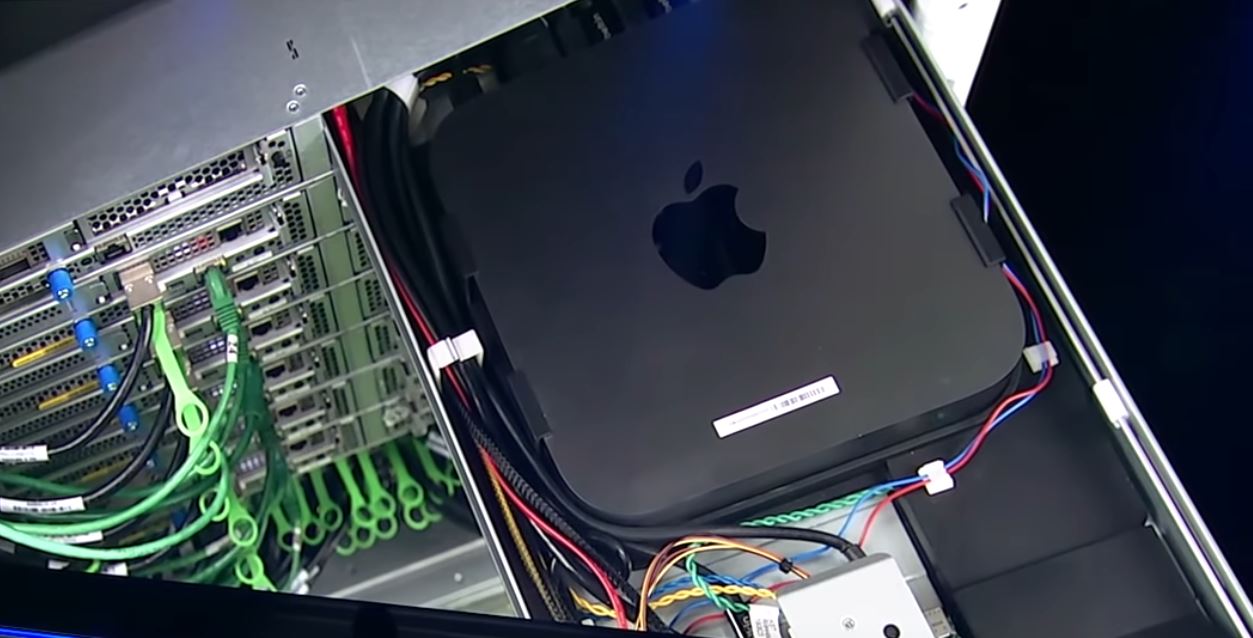
At Amazon scale, I imagine they strip the original chassis and use only the motherboard with custom power and cooling for some insane density. As visible here https://youtu.be/R4ArjHz4gd4?t=192 you could save some significant space doing so.
I imagine you could get 4 in 1U if you used all the depth, and perhaps more dense by putting them onto their side in 4U (maybe 5U..not sure how tall a M1 Mini is). I don't know to what degree cooling is an issue, where you don't want the exhaust of one feeding the inlet of another.
> Our Small Business Experts are ready to help. They’ll advise you on the devices to fit your budget, including special pricing,* and find you the best financing option. All backed by ongoing support to give you much-needed peace of mind.
> * Special pricing available to qualified customers. To learn more about how to start qualifying toward special pricing, talk to a Business Team member in a store or give us a call at 1-800-854–3680.
>Based on Apple not giving a shit what volume you’re buying, the price is the price.
Maybe the rules are a bit different for Amazon, but I wouldn’t bet on it.
You're backpedaling now. Nowhere in your first comment was there any reference to degrees or margins - it was all or nothing (the "price is the price").
I would love to be wrong about it. But I know Apple dont give much wholesale discount measured in hundreds of thousands in unit nor do they give any more discount to Mac than wholesale. At best they throw things like accessories or AppleCare discount as bundle.
That is a premium price if you're using it 40hr/week. Although, asumming they're available for custom AMI, maybe the value-add use case for this is to be able to have multiple custom AMIs for different dev environments and scenarios to rapidly spin up what you need.
Specifically for testing with multiple versions of MacOS: you could develop the code and then test on a custom AMI to make sure it ran in the version of MacOS, no need to have multiple systems setup. (Although I don't know much about Mac dev-- does Apple provide tools to do such testing already without running multiple OS versions?)
Otherwise, I guess it's all just about convenience.
The Mac mini itself is not the only hardware cost for AWS here, though: I wouldn't be surprised if their Thunderbolt Nitro hardware cost just as much each. It has to be a very low volume device (relative to other things AWS does).
Considering Thunderbolt is just PCI-Express, I'd expect it to be standard Nitro hardware (whatever that is) plus an inexpensive PCIe to Thunderbolt board/adapter.
I'd guess they pay much more than this due to some licensing/t&c issue. I haven't read them but I speculate that they same something to the effect of you can't make it accessible to the public as a shared, paid for resource etc and that amazon has a separate agreement and they pay more.
Thinking back to the VMware service provider licensing I saw, Apple probably charges a subscription model that would make your eyes bleed. I was shocked anyone could afford to sell a public cloud offering that used VMware technology after seeing their pricing.


Edit: Sorry, my napkin math assumed a unstated utilization rate of 40 hours per week, but that’s not a great assumption due to the 24 hour minimum. Still, some proportion of machines will be idle, though 75% idle seems like a bad guess.