A detail not included here, but important for people interested in the sea level, is the effects of the wind. Lots of places along the east coast of the US experience mild tides, but a steady wind in the right direction will push sea levels up in various bays and inlets. The storm surge of a hurricane turns it up to 11.
I went down a rabbit hole a few weeks back to discover this. I was so upset with so many wrong explanations including Neil de Grasse Tyson saying we're moving into the bulges.
it's very magical though discovering the beauty of it.
What really gets me is the "Map of the strength of the 12-hr lunar tide" in the Layer 4 section of the article posted, which I haven't seen discussed.
All the rest is swept away, and you have stretches of coastline with tides over one meter, and others with nearly zero, just because of landmass distribution ...
If you moved Miami Beach to the French Atlantic coast, things would get interesting.
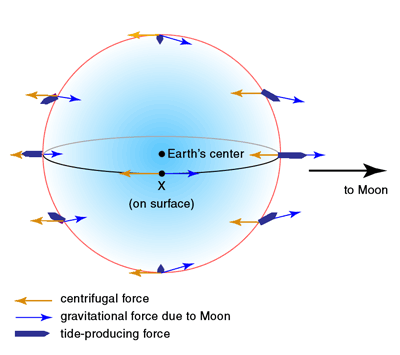
Intuitively you would think that the tide is being formed because the Moon is "lifting up" the water at the point closest to the Moon. But this contribution is actually very miniscule to the tidal effect. Instead the bulk of the tides are produced about 45 degrees away where the tidal force is parallel to the Earth's surface. This has the effect of dragging the water closer to the tidal bulge.
Thank you--the diagram you link is a better explanation of whey the tide "bulges up on the sides of the Earth closest to and farthest from the Moon"--the article left this entirely unclear.
In particular, I could understand how two satellites connected by a cable would result in the cable being stretched. But I still find it hard to wrap my mind around the fact that we get a high tide where the Earth's gravity and the Moon's add (the far side of the Earth from the Moon), but we also get a high tide on the opposite side, where the Moon's gravitational pull is subtracted from the Earth's. The centrifugal force is (I think) a much better explanation. (I realize physicists don't consider that a force, but...)
So yes, tides really are weirder than I think.
(The other facts in the article were actually familiar, e.g. the fact that the tides in Hawaii are quite small, because it's not far from an amphidromic point.)
Tides aren't caused by centrifugal force but by differing gravity. You would be ripped apart by tides falling straight into black hole.
The near part of Earth experiences more gravity from the Moon, the far part less. The Earth moves in the center so the water bulges on the ends. Important part is that the Earth pulls things out their natural orbits.
With circular orbits, gravity and centrifugal force are balanced so could be considered difference on centrifugal force. But that isn't true for all orbits.
but to develop better intuition, think of the sun's gravity as a field in space and nothing is being dragged anywhere, it's just that wherever you are feels appropriate to where you are and where you are going is the path of least resistance, and the places around you feel the same way, and where you all are in relation to each other (in this field) changes its relative position to everything else.
the water of an incoming tide doesn't feel "i'm being dragged uphill", it feels "hey, the earth is moving underneath me". it's all in freefall all the time.
you don't feel like you are rotating at 1000 mph (1600 kph) but you do feel your weight against the surface of the earth. same with the water, except it feels itself being squeezed by everything around it like you only feel that in the entrance to a crowded venue.
so, the water on the side toward the moon and the water on the side away from the moon would mostly perceive the earth as dropping away or coming closer (if they could perceive anything at all) where they are is always their point of reference
The problem of predicting tides was so important that it attracted many Physics and Maths heavy weights. You can well imagine how important predicting tides would have been for D-day landing.
One related fascinating historical artifact is the special purpose analogue computer designed by Lord Kelvin in the 1860s based on Fourier series, harmonic analysis. Think difference engine in it's cogs and cams glory, but special purpose.
Possibly one of the first examples of Machine learning, with Machine in capital 'M'. It incorporated recent tidal observations to update it's prediction.
Note that sinusoids are universal approximators for a large class of functions, an honour that is by no means restricted to deep neural nets.
George Darwin (Charles Darwin's son) was a significant contributor in the design and upgrade of the machine.
Other recognizable names who worked on tide prediction problem were Thomas Young (of double slit experiment fame) and Sir George Airy (of Airy disk fame).
> Kelvin’s machine automates the second half of that task. As the pulleys spin, they pull on a common chain by the correct amount for each of the calculated components. A year’s worth of tidal tables can be put together in half an hour, if you know the components. Even better, you can “guess and check” the components by comparing your machine’s output to past records, and adjusting the pulleys until you get something that works correctly.
I didn't know they already had machine learning and model fitting algorithms in the 1800s, but here we are...
Sometimes we need dates attached - by the numbers (1838 of current 3176) that's probably some 5 or 6 years before ChatGTP. Or 3 or 4 years after the Netflix challenge.
Jeanne Rousseau, who passed away in 2012, asked in an interview [1]:
Why are the syzygy tidal coefficients equal when the quadrature tidal coefficients are at opposite extremes?
Why are the syzygy coefficients at opposite extremes when the others are equal?
Who can explain this using the laws of universal gravitation?
Her point is that you can't.
Earlier in that interview she says:
I was put in touch with the Institut de Physique du Globe [2]. In April 1953, I met with Professor Coulomb [3], who was the director at the time, and asked him about the ionic variations that might occur during the lunar phases. His formal response was that there were none. However, I had already been observing them for some time. I must say that in 1953 I had already begun to observe the phenomenon of the tides. Being told that, apart from a minimum of atmospheric ionization at 4 a.m., there is nothing else that can have an impact on the biological, human, or other levels, I said: but there is the phenomenon of the tides! And that's when I got this response, which marked a break with the scientific community for me:
The phenomenon of the tides is a phenomenon that is beyond us. We waste our time when we take an interest in phenomena that are beyond us. If you don't want to waste yours, focus on other things.
Jeanne Rousseau demonstrated through observation that tidal phenomena are not solely gravitational but primarily electromagnetic. One can read more about this in English in this paper [4].
This is, not to put too fine a point on it, crank science. Opening up the linked document, the DOI fails to resolve, the paper investigates pH variations in urine during tide cycles, and also skimming over it doesn't appear to make a single prediction. This is at best unfalsifiable, and a "break with the scientific community" is an accurate assessment.
The physics of tides is largely well-understood, and the moon and sun provide the primary forcing. Accurate tide tables are regularly computed the world over, with measurements regularly made. Without even looking at measurements, the shipping industry demands accurate tide forecasts for navigating efficiently. The claim that "tidal phenomena are... primarily electromagnetic" requires some serious evidence to back it up, with calculates to boot, rather than invoking mysticism that tides are "beyond us". Many things are beyond our current scientific understanding, and that is humbling, but tides are quite well understood.
Odd weather wasn't mentioned. While weather does not create tides, but it can significantly modify the actual water level compared with the purely astronomical tide that the article describes.
https://www.youtube.com/watch?v=AxC770lpSLw shows one of the old tide prediction mechanical computers briefly mentioned in this article. It is effectively doing an inverse Fourier Transform, summing all the various 30+ sinusoids that affect the tides.
"Q: I live outside of the U.S. and my location is no longer supported. What happened?
A: Many data were purged after a legal threat from the U.K. Hydrographic Office (UKHO) in January 2001. I ended maintenance of the non-U.S. data that replaced them for different reasons in early 2012."
I wonder how much money the Hydrographic Office saved by not allowing this data to be distributed?
I live near a river that flows backwards for some 50km or so with tides. The first time I saw it, I thought I'd gotten turned around because surely water can't flow uphill, right? It's fun to find out that one is so wrong about basic physics.
I know this is unrelated to the actual content, but I have such a visceral reaction to any headline in the "x is different than you think"... how do you know what I think? I am sure many people who read this will be experts on tides, and the title is completely wrong.
For me, the worst are posts about scale and things I won't need, like "You don't need kafka" or "your data isn't actually big data" or "don't horizontally scale, just get a bigger server"
I get that I am not the target audience and there are people for whom those statements are true, but I am running Kafka clusters with data from 10s of thousands of servers, I absolutely can't move that to a single machine.
I wish they would phrase it as "Tides are weirder than most people think", although that probably doesn't drive as much engagement.
It is property of English language where "you" is used in place of "one" very often. This is particularly common in American English which has less formality to it; less Frenchiness. No 'on' etc. Everyone is 'tu'.
It is language quirk, but you can probably use LLM to replace HN headlines like this. Pretty cheap and one will no longer have visceral reaction that one does not wish.
out the back door of my house, down through the field and woods to the water is a 12 min walk at high tide, and another 12 min + walk to the water at low tide, 53 vertical feet between the two.
I know ,not the slightest thing about tides, other than what my senses tell me when walking the shore, and I suppose the practicalities of beach walking along cliffs
are similar to planning and predicting arival times for ships loaded to the maximum draft, the money to be made there bieng the motivation behind the push to understand tides.
huge, and where else?
there are some places here where the slope is so gradual, that the low tide is over the horison
growing up we had a camp right at the end of Burnt Coat Head, in Noel, and never did make it to the low tide line
between there and Cape Split there is the full range of tidal phenominon on display, resonant standing waves, whirlpools, tidal bores(with surfing black ducks),whole bays emptied, and varios dikes and berms, dams, locks, to hold it back
there are one ot two other places on the planet that are close, and from the charts in the article, spots with NO tide, which when I think about,is very wierd indeed
I see I'm not the only geek fascinated by the tide. I knew all the stuff in the article already, of course. It seems it's like railways or something, seems to trigger something in geeky brains. I live in the UK so see some of the largest "swings" in the world. It never ceases to amaze me that it all happens in the space of 6 hours. I've also gone to see spring tides just to see what it looks like. It's cool, and scary.


reply