This story makes a compelling case that women stopped programming because
- 1. Computers started being sold as consumer products
- 2. They were marketed almost exclusively to boys
- 3. Boys played with computers and learned about them, while girls were made to feel that computers weren't for them
- 3. Men showed up to college with more computer experience
- 4. Women felt they must not be "naturally good" at computers, based on how men already knew more
While I think people sometimes exaggerate how much of gender differences come from society, advertising, etc, the facts of women's history in programming are clear, and I think the cause is well-argued here.
We need to fix the perception that women aren't welcome to program. We're missing out on talented developers.
In the Eastern Bloc countries nobody bothered to market computers, for many reasons including closed off markets and economical disasters. They also valued gender equality a lot. But the end result was absolute the same - massive male domination in everything computer-related.
I talked with some of my female friend who were studying CS, and asked them why they many of them gave up on programming and moved on to management or so other non-technical position.
The answer was that programming was boring and exhausting. From what I understand being code monkey who spends 40 hours a week debugging, writing crap code and checking tests with the most repetitive and non-creative manner doesn't gave them as much sense of an achievement as it gives to some men. Hell, I have doing that kind of job and only push on due to money and fact that 95% jobs in the area looks exactly like that. (And the rest 5% requires you tho know right people.)
I would say that there is relatively little of masochist women who would want to debug that race condition hell in C++/Java. There you have to endure a lot of frustration before reaching a (short) moment of satisfaction. On the other hand in some Rails startups that I know, where effect of your work was immediate and one didn't felt that she was hitting the wall all the time there was a lot more of girl programmers - about a half of the team. But there are very few of such startups in my neighborhood. All in all I've got more men around.
TL;DL - women are less of a masochist when it comes to frustrating jobs.
Could it be the operating systems or the UI? There are fewer choices nowadays you know. At least one person I know completely lost interest in the field because of the switch from DOS to Win 3.1.
GUI lived alongside with keyboard-based text UIs for most of 90-s here. Actually it was women who stick to Norton Commander lookalikes for many years. I still don't think it made any gender-balance difference.
Grew up with Atari 800xl in 1980s in communistic Poland and confirm the same. It is quite obvious what happened but first what I really don't like about the article:
Object ovation of women. You have "agents" who decide for themselves -- men -- and objects who need to be told/encouraged or have stuff explained as otherwise they will apparently not understand why they should study CS. Or have mammography ( when was the last time you seen an ad explaining men to have prostate checked? ), participate in politics, etc? You don't tell agents what to do. Agents take action by the definition of being an agent. Objects on the other hand need to be told. Feminism is objectifying women this way.
And explanation of why not these many women are in the CS percentage wise today as in 1984? Easy. As CS became very popular instead of being highly scientific niche subordinate to mathematics department, it just became as any other engineering department - overflown with men.
Btw, I studied English language for my Masters. Hihhly recommended : male/female ratio 1 to 7. 😉
And no, there are no articles encouraging men to take foreign languages as their University Major. As we are not objectifying them as feminists are objectifying women. We know that advising agents would be inappropriate. But if you want to spend 4 or 5 years with chicks around you -- go study foreign language. And you can still pick up programming after partying with them for five years 😉
I don't have data on this, but I'd imagine the popularity of computers in the home in the 1980s was outshining that of chemistry sets. In the NPR piece they talk about how computers were marketed to boys for playing games.
And chemistry is also taught in high schools, so both male and female students interested in it would've had some experience before attending college. The same is not true for computing.
A shift happened where computing was seen as something girls didn't do. If not marketing then what caused it? (IMO it started when computing became synonymous with math, if people thought girls couldn't do math then they also couldn't be good with computers).
When I studied CS , only a small minority arrived with programming skills, a much larger number came with knowledge of gaming and by extension computer building because it was much easier to afford a PC required for the newest games if you could build it yourself.
I got into programming because I couldn't complete a level in a game, and I resorted to cheat-codes and hacks.
First it was the missing-no hack in Pokemon, then getting the console for "sv_cheats 1/god/impulse 101/noclip" for Half-Life and then rules.ini for the Red Alert series.
Hand hacking rules.ini for Red-Alert made a massive impression, any of the game's dynamics could be altered, you could spew out units for $1, bolt a tesla-coil on a tank etc...
Cheats and trainers got me to look into the workings of a computer program, plus the midi music from trainers is addictive :)
> I got into programming because I couldn't complete a level in a game, and I resorted to cheat-codes and hacks.
While I programmed long before then, that's certainly the reason I started poking at hex editors, and why I remember off the top of my head that 0x63 is 99 and 0x64 is 100.
Yup. I started programming at 13 because I wanted to make my own better (obviously) StarCraft. Poking around in existing games and trying to make my own during my teens is the sole reason I work as a programmer today.
Many people who get into programming, do so because they either want to make games, or like computers because of games. This was widely true among my CS class at WashU, and also many of the professionals I currently work with.
6. Males are far more likely to enter jobs they're not suitable for
Of all the "programmers" without any aptitude that seem to plague corporate IT departments, virtually none of the ones I've come across have been female. If you take out these frauds when counting programmers, then the gender balance in many IT departments becomes more like the early 1980's. Added: When programming became a perceived status job, the frauds turned up to cheat aptitude tests, lie on their CV about experience and studies, and what not.
I've met more than a few women who majored in computer science and were then diversity-hired into corporate positions involving programming, with no skills or aptitude for it beyond sophomore-level class projects. They tend to get shuffled around to less technical positions eventually.
I was one of those boys who bought a TRS-80. The thing is, I don't remember it as a peer accepted pursuit for me either. This was before anyone noticed, let alone Hollywood recast it as their version of Revenge of the Nerds. This was when being a nerd was not nice.
While I did get some quasi support from people who thought it might help in a career someday, the much more common response in those days was "who needs a home computer?"
Update: I agree that we should encourage everyone with an aptitude now to go into higher ROI fields (of which CS is one), I do think it is a bit reconstructed history to make TRS-80s actually "cool" and "non-cool kids excluded."
Indeed, the TRS-80 was not even a game machine. PCs as game machines came a bit later, and as price effective ones, much later.
Back before anyone was really marketing computers in any mainstream way, I remember gathering around the few that were available in the school library or in a math teacher's classroom.
I was interested in high school but felt like I wasn't allowed in the computer room. It was full of boys who knew the teacher, and I didn't know the teacher and wasn't a boy, and just didn't really want to deal with the social discomfort given that I had a computer at home and could use that for an hour in the evening. Instead I skipped class in a computer-less room with the IB coordinator's blessing.
That hour or two a day of skipping class or eating lunch would have had a different effect if I'd spent all the time playing with computers.
I started making up for it in college as a CS class was required, I couldn't afford my own computer & so discovered the trash and Linux, and there was a badass female sysadmin who demonstrated perfect ease in owning the computer lab.
Maybe it doesn't matter. Once a group becomes predominantly one culture, it rapidly slides to that corner of the culture space. Lots of reasons - people hire people they feel comfortable with. People value people they understand more, regarding them as more intelligent or harder working.
Seems fairly self-evident - personal computers grew out of the electronic hobbyist industry. The first home PCs were kits for Radio Shack geeks. The PC market was firmly established as a split-off from the electronics-geek market until the early '90s or so.
The best explanation I've come across so far is Roy Baumeister's Is There Anything Good About Men? [0], which explains gender determinisms by regarding the evolutionary history of our species. The article was already posted several times on HN [1].
My take on that missing piece: once computers went personal / homebrew / RadioShack they switched categories. The new category was "tinkering with electronics", which has a long established cultural perception of being a male activity (and those personal computers were therefore marketed to males)
I know I'll get banned and cursed for years for that but here you go:
Oh stop it, those are gender differences and girls also enjoy their differences, even if they're unfortunately imprinted by culture. They're untouchable, they are given what they ask (which is: often dolls), they're social. And the few that are in IT, they don't show up at the Java User Group, even if it's their job, even if it's free, even if it's at the same time as for boys.
They do show up more often at higher-class networking parties where they may make connections with product managers and be promoted, rather than stay programmers like us for a bit longer.
Of course there will be counter-examples, but I see girls in IT getting promoted MUCH faster than boys. In my 14-people office? 4 women-project-managers, 1 woman-architect (who doesn't know GIT), 1 female programmer (with 2 years of experience) and 8 male programmers. Yes, I'm making this observation about my team to imply that women have better jobs, sooner than boys, and it does imply that males don't get promoted as easily as women, at least in the world around me, and I'm saying an IT career is an excellent path for a girl.
Before anyone says "Women get promoted quicker because they're just better at their job", I'd note they turn over this exact argument when it's directed to boys, by suggesting they didn't get the education, incentive, support or opportunity. It's not about anyone being better. It's about how we reach fairness.
I do see that some of the world is different for girls, but unfairness is reported more often than advantages.
Edit: "Why are there less girls at the JUG, is it because they're uncomfortable with 95% men?" > Or that they aren't involved much and reserve their evening time for their social life. The only way to be sure would be to ask them, and they'll probably remark they'll be promoted whether or not they attend the JUG, if you've followed the story of my team.
It seems to me that you are considering only symptoms of more underlying driving forces here. For example: Why is it that they don't show up at the Java User Group? Maybe they feel uncomfortable in a room with 95% men? Then you would have to explain why there are 95% men in that room in the first place.
Women probably get promoted relatively earlier for reasons like token women and the fact that they less commonly have computer experience since early on.
... which will hopefully explain why Lego markets the normal* range to boys. Or not.
Of course there's the Lego Friends range targetting girls, but it is once again about houses, cooking, flowers and rainbow poneys, and not at all as educative as Lego Technics.
*Such as the Lego City and Lego Creator ranges which must be the legos we encounter the most.
I completely agree. I had never programmed before my first college course, and while I had a lot of fun in intro programming courses, I always felt way behind everyone else and didn't do particularly well. Those first couple of classes filtered me out of any chance at getting into the CS major, and I ended up transferring schools to study it.
I find this explanation extremely hollow. Most programmers didn't start programming when they were kids. They started when they realized it was a good paycheck.
But the "gendering" of computers affects everyone, regardless of how or when they get to the table. I've known many women who found themselves regularly condescended to and even verbally abused by their CS professors, and many of them just dropped out entirely rather than face an academic discipline that quite vocally didn't want them involved. (Is this the norm? I hope not. Is it common? I fear so.) And once they get into the industry, they continue to face scorn and opprobrium, although some sub-disciplines (particularly database administration, ETL and data modeling) seem to fare better than others. Not distinct to the comp-sci field, as any female executive or high-grade salesperson will attest, but I'd like to think we're better than them.
Hmm.. I wonder if that's true of younger programmers, but I don't think I've met a single one around my age (early 30's, late 20's) who didn't start when they were young. I got my start near the end of high school and I felt _impossibly_ late. I still do, frankly.
> I don't think I've met a single one around my age (early 30's, late 20's) who didn't start when they were young.
This is probably partly confirmation basis and partly insufficient data. I doubt every time you meet a fellow developer you ask them how old they were when they first started programming.
I'm 35 and didn't start coding until about four years ago (when I decided to go back to school and switch careers) - there's another dev on my team that started even later, and I know several that never wrote a line of code before college. So yeah we're out there.
Any data on that? I tried searching for info on when the average programmer started, but couldn't find anything. I always figured most programmers started young, but that might just be because so many in my group started really young.
That you know about. The article shows a drop-off starting in the 1980s, which was when the home computer revolution happened. Computer games magazines at the time printed out programs for users to type in themselves, because for the first generation or two of hardware there wasn't a whole lot of software to buy. Also, pre-built home computers were heavily marketed for their education potential.
I'm another that didn't start programming until one of my required courses as a physics undergraduate student. We did have an 8th grade programming class but everyone took that and obviously it didn't spur me into any interest in programming.
Maybe today that's the case. I doubt it was true in the 80s or even the 90s. I think the "Gold Rush" mentality in programming is a post-1999 phenomenon.
I am a female born in 1983 and have always been deeply interested in computers, but have nonetheless felt inexplicably out of place for it. I was in advanced math classes my entire life and placed out of calculus in college. I took a summer programming class at a different university in 2000 and fell in love with programming. But when I got back to school, I took another CS class that was exactly as described in this article. I can't quite articulate the feelings of isolation and frustration I felt in that class, but they were strong enough to drive me away from CS and engineering for a long time.
>I can't quite articulate the feelings of isolation and frustration I felt in that class
Male nerd here. My god, I couldn't get along with 90% of my class. They all seemed to be disagreeable in a "technically correct is the best kind of correct" way, but also with lots of arbitrary fanboyism and a complete lack of basic social skills or outside interests. Not to mention the petty competitiveness and complete lack of any team player skills, and usually a huge amount of attitude dismissing these types of skills as useless.
Meh, I suffered through it (and through many coworkers of this type) as the price of business.
I'm not sure why women assume its all roses for men in these fields and classes. I dislike jerks as much as you. Heck, when we do hiring, we aim for social and inter-personal skills first and technical skills last. Its easy to find a difficult non-team player misanthrope who knows x, y, z. He's just hell to work with. I'll take the easier to work with the person who knows just x and can eventually learn y and z.
Also, this female dominated computer industry of 1970s and 80s has been shown to be something of a myth. A lot of those degrees and jobs weren't programming heavy and in practice were mere data entry or computer operator jobs, not necessarily coding. As the industry changed and those jobs moved towards administrative categories so did the women with them. IT departments dont have a team of data entry specialists anymore. They're put elsewhere, or have been eliminated altogether. If anything we have more female coders, who actually code, than ever.
> Male nerd here. My god, I couldn't get along with 90% of my class. They all seemed to be disagreeable in a "technically correct is the best kind of correct" way
You got off easy.
I went to a top engineering school out of high school, and can't tell you how many times I was berated, called names, and cursed at for being an "idiot" who didn't know things like the resolution of certain VGA modes by heart (except in that particular case, the other guy was wrong.)
I do understand that this would be more intimidating were I a woman, but still.
I think the responses you're getting here are indicative of the environment. "Oh, you felt uncomfortable? That shows you're weak, because I was uncomfortable and I didn't quit. Not my problem, sucker!"
You're not alone. I've been in those environments. I have not battled on to conquer, although I've continued in math and computers. I have kept my head down, avoided a lot of people, and cultivated only those who I like to work with. Once I have a base of nice people I can deal with in a field, plus some competence, I feel free to roam further. But it's not in my personality to sacrifice my mental health or happiness for the pleasure of hanging around with assholes or people who don't want me around. I've made some peace with that.
Hanging around mostly with people who can work with me respectfully also leaves me the energy to deal with the others now and then.
If you really love programming, it does not matter what other people do. You learn more alone in front of a computer, solving things, than in a classroom. Youn do not need a degree to hack.
What jumps to mind, and what few people ever want to discuss, is that one of the possible differences between men and women - that women seek out highly social jobs / career paths at a higher rate than men - might be in play. That is, that women find it harder to suffer through the loneliness that can come with being a hacker.
I spent a lot of years working by myself, entirely alone. It never bothered me, all I wanted to do was learn and build. I've never met a woman in my entire life that would have been ok with that isolation.
Same here, I dropped off of Informatics Engineering (that's CS engineering in Italy) partly for the same reasons, even though I had very good grades and liked it.
I ended up working in the field anyway. I ended up getting a BoA while working, though.
Plot twist: I'm a male.
That's not to say that your examples doesn't apply, far from it. But as someone else commented, the environment on those courses... wow, that's really far from the culturally stimulating CS environment I envisioned before enrolling.
I am a female born in 1987 and have similarily been interested in programming for a long time.
After reading several comments, I'm getting some sense of resentment that you were driven away from your passion while others were able to stay on course despite
similar obsticles. I in no way wish to diminish their accomplishments or claim any secret insight into any hardships they had to overcome or did not have to overcome;
however I feel there are some aspects that are unique to the female experience of 'isolation and frustration' in learning how to program that I wanted to clarify:
Starting off, it is not at all unusual to be the only female in the class/room. The reason this is horrible is not because there's no one
to talk to or connect with, but because it's completely impossible to shake off the feeling that everyone is watching you, very closely, all the time.
Having this constantly on your mind hurts your concentration, your productivity, and your ability to freely explore ideas without judgement - a very important part of learning. This is something that the female needs to come to terms with and learn to be comfortable in her own space regardless.
Second - and this one hurts to type because I can feel the coming backlash - you programming gentlemen can be a bit too... helpful.
When a female does need extra help in understanding something, help is appreciated and needed!
However, when several people, usually male, come at you at once wanting to help it can be a negative experience. As good intentioned as this is, it is incredibly frustrating for me for three reasons: 1) the more people that want to help only fortifies the pervasive paranoia discussed earlier, 2) the more people that want to help me highlights my knowledge gap and is incredibly discouraging,
and 3) gentlemen, when helping a lady in need of something, you tend to get a sense of bravado and in an effort to show us something, you end up just doing it for us.
When this happened to me, I not only missed out on an opportunity to do a task myself and learn, it also served to fortify the sense of "move aside, young lady, and let
the men take care of this." Furthermore, once a female smarts up to this enough to be brave enough to refute said help, she will often do so in an unappealing way until she learns what gets the best response. I want to point out that I don't blame yall males at all, and this is something a female will need to learn to deal with.
For the record, I stuck with it and got my CS degree. I think this has more to do with stubbornness than fortitude.
All this said, however, I've come to be pretty blind to the gender gap in my day to day and try to shy away from these types of conversations because there is no winner.
Starting any field of study will have its own set of unique challenges that every student needs to overcome. Right now, for females as well as males in software, one of those
challenges is how to treat the gender gap. I'm pretty much over it.
As someone who has always thrived around computers and programming tools, I wish I also had a History degree. Some of the most interesting stuff I have ever read is history related.
> have always been deeply interested in computers, but have nonetheless felt inexplicably out of place for it
You know what stopped me from becoming a professional programmer? It wasn't the fact that I didn't get to study CS in high-school, nor that I didn't have a PC until I was a university student, nor the lack of Internet access at home until I was 20+ years old, nor the language barrier (English is my third language), nor being limited to free resources by my finances.
Nothing. Nothing stopped me from pursuing my interest.
That's a pretty rude and condescending response. Feeling excluded from a particular culture is very different from expecting a task or learning a skill to be easy. Imagine trying to learn a new skill and finding that your peers & superiors in the field are hostile to you but friendly to each other. This is the experience many women report and I've witnessed it myself.
If you wanted to learn something, say, plumbing, and found that fellow plumbers viewed you as an effete nerd, would you just lay down your wrench, or would you resolve to be the best plumber possible and soldier on? Which course of action do you think would be the most rewarding?
She's not talking to some faceless group or venting in a vacuum, she's on a website that is a community of programmers. The plumbers have every right to think I'm an effete nerd, but if someone tells me my misogynist behavior is excluding women from the field of programming I care.
The graph you linked to. I'm comparing the 1984 numbers to latest available, since 1984 is what the linked piece talks about (and which I mentioned in the original comment)
> drop off was nearly identical for men
> women did seem to drop off more
These two statements cannot be both true at the same time.
What are you trying to prove with this cherry-picked time points?
Author notices that number of women in CS significantly went down in 1984 and searches for reasons. According to the graph provided in the parent comment it was actually CS as a whole which went down.
Both lines on the graph are awfully similar, and one can assume that there wasn't any sudden catastrophe for women in CS at that time.
When analyzing 'What Happened To Women In Computer Science?' the absolute number is not important, but the ration of women in CS and when that went down (and why).
In this case, a drop off needs to be compared to a peak value which 1984 is not. 1984 is before the 1986 peak. I'm not saying they're exactly identical but it's clear that there are similar patterns. Perhaps not "nearly" identical, but similar enough.
"This idea that computers are for boys became a narrative. It became the story we told ourselves about the computing revolution. It helped define who geeks were and it created techie culture."
The facts seem to (rather) be that computers were no longer just toys, they were becoming serious tools. As such, "tool geeks" gravitated to computers. This hypothesis would explain the inevitable sexist outcome of the field with a simple explanation. It can also be verified objectively and orthogonally by looking at other "tool" drivem occuplations that seem to share a heavy gender bias. See, eg
Playing with tools and machines is not so much sexist as it is anti-social more broadly speaking.
It's not clear the both genders share similar preferences in thus regard.
If you look at more "social" industries (or business functions) like in Media/publishing/advertising you tend to find a significant number of very successful/world class etc women in very high powered jobs.
The bigger question is when did coding become so anti-social? And is/was this anti-social nature somehow necessary or functional?
> Playing with tools and machines is not so much sexist as it is anti-social more broadly speaking.
Asocial is a better term. Unless you're talking about the "mad scientist" (mad engineer is a better term...) that builds machines in order to take over the world.
The "women just aren't as interested in programming" trope rings hollow when the participation of women in CS majors is about half of what it was in 1985, a time when, by all accounts, programmers were far less socially mainstream than they are today.
My hypothesis is that women (specifically teenage girls) just aren't interested in the field / profession so they decide not to study it in school or search for jobs in the field.
Perhaps this is because they are discouraged from trying it by their teachers or media, perhaps its because they don't have the confidence to believe they'll succeed, perhaps they think it's not cool, perhaps they don't think it'll be a fun job.
But I guess, I see "women aren't as interested in programming" as a very likely cause for the disparity. And I don't think that's a sexist observation. I believe if we can find ways to get more girls interested we should pursue them, and indeed I root for organizations like Black Girls Code.
We live in too politically correct a world if we think it's bad to suggest that maybe girls _aren't_ interested in the field. I'm not sure that it's the biggest contributing factor, but if it could be part of the story, why are we so afraid to admit that possibility? Because it's not something we'd like to believe?
What does 'not interested' connote? And how do you frame it?
Consider these two statements:
1) The female sex is intrinsically(biologically) uninterested in Computer Science.
2) Girl's are raised in an environment that pushes their interest away from Computer Science.
In each statement, girls are not interested in Computer Science. But the first statement carries a tremendous amount of baggage with it, and comments on significantly more than cultural interest. It is, to put it lightly, a fantastic claim. And fantastic claims require fantastic evidence.
I don't think anyone is afraid of admitting that girls have been less interested in pursuing Computer Science than men. That's not really at issue. What's at issue is the cause and context guiding the group's interest.
And those properties that statistically discourage an entire sex from pursuing Computer Science are...
The problem is that I have seen no significant evidence to support such a claim. And on the flip side, it seems rather straightforward to argue for culturally guided decision making. Marketing, toys(Barbie vs Tools), socially approved courses(home economics vs woodshop), socially approved professions, 'traditional' family roles, historical religious convictions... These make for a convincing argument. And they're especially so when you begin to dissect the progress women have made in other professions, and the changes in cultural attitudes over time that have helped them make and hold on to such gains.
It's a great question. Why are women dramatically less interested in construction, coal mining, being fire fighters, joining the military, working on oil rigs, becoming welders or brick layers, etc.?
The two arguments are: it's either how we're wired, that is that we're wired (or even physically built) in such a way that we end up liking or pursuing different things; or it's society / social pressure or influence.
I wish we could scientifically prove once and for all, that men and women are identical, and thus should inherently like identical things; or that we are in fact different in various ways, and thus inherently are going to like different things to different degrees.
Do men and women like programming at a different rate because of how our brains are wired? It seems to me we'd have to start by determining whether our brains are different in such a way as to make that plausible; and if that's not the case, then it practically has to be a social driven issue. Now, how can we determine the brain aspect?
"Should"? They "shouldn't" be one thing or the other. They, as a group, seem to be, but why is that a threat to you if you like fishing? Just because there is a pattern to something, doesn't mean that that pattern is good (or bad, for that matter).
Why do we take such offence when people point out a trend or pattern, and we ourselves are an exception to that pattern (I say "we" as in many people, including myself)? Is it because we think being normal is superior to being unusual, and that we not being part of something that some other person thinks is normal is an implicit threat to our threat as normal people?
OK, well it wasn't really clear by the parent comment whether they were referring to nature, nurture, or both. And I don't think it really matters. He just said
```
[the] "women just aren't as interested in programming" trope rings hollow
```
To me the comment implies he is "afraid of admitting that girls have been less interested in pursuing Computer Science than men".
Why is the first claim more 'fantastic' than the second? Why are nurture-arguments so often viewed as perfectly innocuous and impartial, while nature-arguments are viewed as so controversial?
Throwing around unsubstantiated claims about how "society molded them into who they are" seems like a very fantastic claim to me. And I see a lot of that kind of argument going around.
The "aren't interested" hypothesis would also need to explain why the physical sciences haven't had the same decline in involvement as computer science nor why there is a specific decline in participation in computer science but not in the other categories.
I don't think anyone is afraid to suggest that girls aren't interested in the field, it's just that it is a very unsatisfying answer and it doesn't really make sense to generalize about more than half the population.
|it doesn't really make sense to generalize about more than half the population.
It does in the context of gender. Sure there are outliers but men and women are generally interested in different things. To deny this is to fail to realise a huge aspect of human behaviour.
A) I'd love to see a citation about the differences in interest between sexes (or genders for that matter).
B) Even if there is a difference for some statistically significant degree, given the population we are talking about the outliers can matter a tremendous amount (for instance if "only" 20% of women are interested in computers but are forced out due to culture, that is on the order of 30 million humans).
C) Even if there aren't massive amounts of outliers, gender interest continues to not explain why the computer sciences participation decreased over time and other technology professions didn't.
You can't be serious about thinking there's little difference between what men and women are interested in.
I don't know very many men with a strong passion for clothing, fashion, shopping, etc. Maybe 5% of the guys I know are passionate about those things. About 95% of the women I know are.
Sports. I really don't need to explain this one. If you've dated more than a few women, you'd find most of them have a relatively low interest in watching sports on TV. They'd rather be watching True Blood, or Gossip Girl.
Babies. My Facebook feed is non-stop overwhelmed with women posting endless parades of baby related content. Babies, babies, babies, all the time. This is a 27 / 40 something female thing in my observation. None of the guys do this, ever, outside of occasionally posting family photos.
I guess that must just be the people I know, and it just happens to perfectly match up with the cultural stereotypes.
Let me just say that I of course think there is a difference on average between what men and women report they are interested in but:
1) I don't think it is statistically dominant enough to be important for conversations about nuanced topics like computer science education. That is, just because on average more woman are interested in Gossip Girl than men, has no bearing on the difference between potential interest in computer science (especially given that an interest in computer science is already such a small minority of all people).
2) What people report they are interested in and what they would be interested in absent cultural stereotypes are 2 entirely different things. On big picture topics we are unlikely to change those stereotypes in a reasonable time frame but for something as constrained as CS education, the stereotype can (and potentially has historically) changed. For instance, to use your example, there are many, many women who are not in the least bit interested in babies, but they cannot admit this without an extreme social stigma being attached. Conversely, what would you think about one of your male Facebook cohorts posting an endless parade of baby related content? Those stigmas filter peoples behaviors.
3) social stereo types are extremely compelling minus data. For instance, I find your claim that 95% of woman are passionate about clothing ridiculous and the converse of 5% of men is also idiotic. It also may be extremely dependent on your neighborhood, background, location etc. Without data we can't know which of us is right, but many many people will assume you are.
4) Your sports example is also particularly pernicious. There is this belief that woman aren't interested in sports, yet at the youth level woman participate in sports at nearly the same rates as men. So if woman are interested in sports growing up, but have lower average televised attendance (and if you look that number up I bet it isn't nearly as disparate as you think) we can either assume that woman aren't interested in TV sports due to some inherent "woman-ness" or we can attribute it to sports on TV being targeted at men. If it is the latter that says nothing about differences in interest, only about differences in accommodation. There is at least circumstantial evidence about Sports being interesting for woman when you look at the viewership surrounding the Olympics. Figure skating & gymnastics post dominant TV numbers with high percentages of woman viewership. I'd also say that your data set of women you've dated might also be biasing your world view on this.
I can't add much more than just curious guesses into this discussion but someone else mentioned the idea of video games attracting people towards programming. I'm pretty sure there is a strong male sexual preference towards video games as children and teens. I wonder if the rise of popularity of video games could coincide with this change? It doesn't have to be that women became less interested, it is possible that a new demographic of people (which happened to skew heavily male) became interested in programming. But anyway, I have nothing to back that up, just spitballin. :p
I agree that it is strange that the drop isn't as large as it is for women in STEM in general, but I don't think it disqualifies the hypothesis.
I guess from my perspective if you only have a handful of women even entering a CS department in university in the first place, then the first and most important problem to solve is why they don't seek to study the major, or participate in high school programming classes. I believe if you can answer that question and remove that factor, it will be the biggest first step.
Disclaimer: Was a CS major, dated a CS major woman who coached me through Calculus and who I collaborated with in software classes. I'm biased.
The question is: why would female participation in CS drop by half from 1985 to today? Why would innate preferences change so dramatically in that time? Certainly, the usual characteristics trotted out for why CS isn't attractive to women were even more true in 1985.
I don't think it's entirely fair to say that female participation has dropped since 1985. The raw number of women has not, in fact, dropped. In fact it has risen, it just hasn't risen as fast as male participation.
This story just isn't convincing. If anything, the legal field has always been more hostile to women, and now it is becoming dominated by women. The same was true of advertising, PR work, sales, and any number of other fields previously dominated by men, and now slowly being taken over by women.
More than 50% of my law school class (top ten law school) were women. In law school the know-it-all assholes were still mostly men. And that didn't seem to dissuade the women one bit from pursuing a career in law. In my first legal job, more than 50% of the first year associates were women. In my wife's firm, 70% of the first year associates were women.
When I was an undergrad (early 90s) there were about 40-50% women in the CS introductory classes, but by the 200 level classes, there were only about 10-15% women. I was pre-med for a time. Pre-med classes were just as hard ... the attrition did not change the sex ratio in the pre-med classes.
Why do people insist on making up all kinds of just-so stories to explain the discrepancy in numbers of women and men programmers. Isn't it possible that women might not be interested in programming in the same numbers as men. Even within the male population, those genuinely interested in programming seem to be a pretty small number.
Most of my classmates in the CS program did not stay programmers. Many of them went to work for places like Goldman, McKinsey, etc. In fact, those were the preferred jobs in those days. Only a very small number of us wanted to actually program for a living.
I don't know, but here are some possibilities:
1) Change in competition in classes that were graded on a curve. If CS became more popular, it could have become more difficult to be an A student.
2) Change in curriculum. CS could have gone through a change in subject matter. At my alma mater in the early nineties, CS included a huge amount of math. The Math and Physics majors also had the same kind of ratio distortion as CS. There were no advertisements to boost male enrollment in Math and Physics.
3) A few new majors were created (like Operations Research and Industrial Engineering) that offered admission into lucrative jobs like banking and consulting, while being much lighter on the algorithms and math. A large number of people from CS went into those majors (both male and female). There were certainly a lot more women in Operations Research. People used to comment on how OR had all the women, and CS had all the immigrants from Asia.
Looking at the raw data, there's a boom in computer science degrees in the mid-80s, for both men and women. Then there's a significant drop-off, again for both men and women. However, in percentage terms the drop-off for women is larger.
To me, that suggests a narrative where the "bust" painted computer science as a less reliable, more risky field. As a result women were less likely to go back into it.
A similar boom/bust happens in the early 2000s. Again, the female share drops more and recovers slower.
I think the graph here -- http://www.randalolson.com/2014/06/14/percentage-of-bachelor... -- provides an interesting contrast. Seems like what has happened is the percentage of women in CS was tracking along with that in architecture or the physical sciences, and whatever happened in the 80s caused it to gradually move down towards (but so far always above) the percentage of women in engineering.
That's an interesting graph. The article makes the claim that this was an effect of computers basically being sold as toys (which are almost always gender targeted in their marketing). But this graph also makes me think about the huge and longstanding push to align software development with traditional engineering practices...that may also have been a contributing factor.
Maybe just a total coincidence, but the mid-80's is also the time when media and authorities started their witch hunt against hackers and the word "hacker" became equal to "criminal".
Basically, in the mid-80's the predominant media image of computer engineers was either social outcast of criminal.
You know, this might have more to do with it than the actual marketing of the time. As shown in another post here, home computer makers tried to market to the whole family. And why wouldn't they? Computers were relatively expensive and esoteric, why not aim at their uses for everyone in the family? And they did.
But WARGAMES and that whole media portrayal that followed of the computer hacker/enthusiast was definitely male and outsider.
This argument seems to rest on the assumption that women are fundamentally more susceptible to decisions based on stereotypes than men are. Do you have any evidence both that this is the case, and that any measurable difference (if there is one) is significant enough to blame for this effect?
Were you there? I was. Computers were marketed to boys and families for whatever reason reinforced this as well. It may not explain everything, but it explains the genesis of the situation.
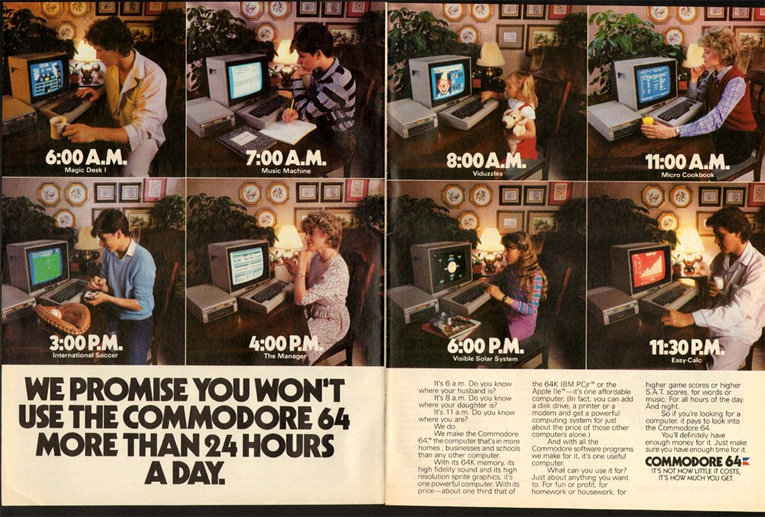
The article implies that, in the 80s, home computers were considered nothing more than glorified pong machines and girls were never seen in any of the ads, which is simply incorrect.
There are countless ads featuring Commodores, Apples, and Trash 80s displaying spreadsheets, and quite a few with girls at the keyboard.
Is there an exhaustive study of computer marketing from that time? I ask in all seriousness, because two links and hazy memories from NPR isn't very convincing.
I was there. Home computers were a new thing, so the marketing was a little clunky, but print advertisement usually had both boys and girls in them, as did the Atari 2600 commercials. "Bits and Bytes" was one of my favorite TV shows as a kid. In it, the male actor played someone approaching a computer for the first time, and the female actor played the mentor who showed him how to do things with it, including programming.
Edit: uh, something happened with comment parenting, but anyway, yes, not every ad was mono-gendered, but in practice boys monopolized the C64s and TI-99/4As of the world.
It's chicken and egg situation - it was perceived as a "boy thing" so was marketed at boys. The 80's in the US & Canada weren't exactly Saudi Arabia, but toys were as gendered if not more so than they are today. And people marketing computers had no social agenda, they just took the path of least resistance.
It is, on some level, similar to the tragedy of the commons. Everyone made a decision that worked well for them and in the end the net effect was one that had a lot of negative impact.
So your two piddly links trump their two piddly links?
Less flippantly, the larger point they were making rings true to me -- speaking as someone who, like one of the interviewees, got the initial push toward computers by hanging out at Radio Shack in the late '70s. Hobbyist electronics was mostly guys, and companies knew that. Microcomputers, back in the day we actually called them "microcomputers," came out of the hobbyist movement. And as for the part video games played, which was also a big point they made, well. If you grew up going to arcades in the early '80s, then you probably don't remember them as having a particularly balanced gender distribution. I sure don't. From very early on the basic plot of most video games was "shoot all the bad things," and that's a kind of play that boys engaged in far more often than girls. (Girls had dolls, boys had action figures, don't you know.)
Sure, computer companies occasionally put out ads trying to demonstrate that computers were for more than just playing video games and doing business work, and that they were Fun For The Whole Family! (tm). But I think it's quite a stretch to suggest that this disproves their whole thesis. They didn't just "link to two piddly commercials," they talked to men and women who went to school at the time and researchers studying this, and noted that when Carnegie Mellon added a class which was more or less "Basic Computer 101" -- teaching the stuff that they theorized boys were getting before they got to college and girls weren't -- the number of women who stayed with their CS program rose dramatically. This would seem to be fairly compelling evidence that there's something to this thesis.
> So your two piddly links trump their two piddly links?
My first link includes more than one ad featuring girls.
They cited two advertisements and interviews with "hundreds" of students trying to recall why their parents bought computers.
If you're going to make the bold claim that computers "were marketed almost entirely to men and boys," then you've got to present some data on the marketing of the time. Especially when there are counter examples to the claim.
Even something like, "here are ten thousand computer ads from the 80s and boys outnumber girls by a significant margin" would work.
> Notice the door, calculator, phone, card file, and dollar bill graphics. Trying to select these does absolutely, completely, and totally nothing. That's right, they don't do anything. At all. This leaves one to speculate if these were supposed to be features of "Magic Desk II", parallel release versions to the "Type and File" cart, or future disk based utilities.
Note that Autism and Asperger's Syndrome are "male dominated". Something like 4:1.
If you have a field toward which nerds gravitate, it will become male-dominated.
What happened around 1984? Yes, home computers were becoming much more common as the article aptly notes.
But what else? It was becoming obvious that the people who flocked to these things most, who outright related to these computers, were nerds.
Popular culture latched on to this instantly!
What was on the big screen and on TV?
- War Games (1983)
- Superman III (1983) - Major character is a computer nerd played by Richard Pryor (August "Gus" Gorman).
- Riptide TV Series (1983) [1] - Major character Murray "Boz" Bozinsky is an utter nerd
- Whiz Kids TV Series (1983) [2]
When 1984 rolled around the trend went all out:
- Revenge of the Nerds (1984)
Nerd stereotypes were in the spotlight, as well as the connection between nerds and technology, especially computers. And that of course is going to have some effect on enrollment in fields of study having to do with computers. Young people respond to stereotypes in mass culture.
I think it's also important to note that the timing. Some of the first real mainstream home computers started selling around the time people who were graduating college in '83 and '84 were in middle school or starting high school, ripe time to start monkeying around with a computer.
Encourage her to build and create things. If she chooses the computer as her tool, all the better, but provide her with as many avenues of creation as possible (paper, sound, words, images, code, wood, ideas, etc) and she will find the one that's right for her.
She is a teenager, I believe you are not her guide anymore, but you can (and should) be an amazing facilitator and her #1 fan.
Does she like math puzzles? I came across this recently, about Mary Somerville. She's not exactly Ada Lovelace, but close.
At the age of fifteen she came across a mathematical puzzle in a ladies magazine (mathematical recreation columns were quite common in ladies magazines in the 18th and 19th-centuries!)
The only one she didn't enjoy was cooking so I didn't send her back. But she does ask me for more girly stuff though I don't know what that looks like :(
I know one of top female coders in Google who worked on Maps. She said her dad taught her a few things in java when she was young. Her dad would give her some sort of reward of every little school problem she could solve with java. Before she even grew boobs, she made a word problem solver based on the STUDENT paper http://dspace.mit.edu/bitstream/handle/1721.1/5922/AIM-066.p...
Romantic story telling for a line graph, but really it is more like the profession of computer operators, originally drawn from the largely female secretary pool, disappeared as computers evolved from big buildings where you submitted decks of punched cards to their modern form.
Nowadays we have IT, EE, CS, etc. but these are really different professions than what was originally mostly women. The first crop of nearest equivalent computer scientists usually majored in mechanical engineering, simply because there were no computer majors yet and the computers were much more mechanical, and had the same gender imbalance we see today.
I had a very similar experience when I entered one of the best universities of Iran in 2000. Although the number of female students were almost as much as males, every professor assumed that students should at least know one programming language and be familiar with all the basic concepts of computers. and many students, especially female ones did not have that knowledge prior to university which was a great turn off as they realised they would be easily judged by their lack of knowledge. The sad thing is that all of these students were great in their high school in order to get in in the first place.
* The number (not just %) of women studying computer science. Did those numbers fall, or stay the same? Was it just that more men entered the field of Computer Science?
My hunch (clearly not backed by any data) is that prior to the mid 80's, Computer Science was a niche field, so there weren't many people who went into CS.
As CS jobs became more mainstream (given the advent of the personal computer) more men went into Studying CS, instead of other fields they had been in. With more men studying CS, more men ended up in CS jobs, and eventually you end up with male dominance.
I would love to compare these rates, with what were the top engineering/science jobs in those times, and see of there is a correlation between the decrease in manufacturing/engineering, and the increase in Computer Science jobs.
Perhaps it's also cause and effect. There were more medical and legal jobs, so women entered those professions, and were able to fight to get equality. Since CS was relatively new, the barriers that women face hadn't been knocked down. As time goes on, there were more female doctors and lawyers for girls to have as role models, leading to more women studying in those fields.
The National Science Foundation study that this is all based on has the raw numbers, as it were, for each degree (at each level Bachelor, Masters, PhD), for each year.
If you want to do some digging on your own, it's in XLS and PDF formats here-
Wasn't the early-mid-80's when programming/computers held much of a social stigma (ie nerd, geek, etc were insults). The market followed that trend and instead of offering a computer as a consumer gender un-biased product, it was marketed at men.. But even then, if you look at ads from around that time for computers.. It's a computer. It's not something that you can assign a gender to in advertising very effectively. It's the social aspect surrounding computers that does that.
Also I disagree with what nathan_long said regarding "Women felt they must not be "naturally good" at computers, based on how men already knew more". To me that is absurd to assume that woman would think that "men know more than us, so why try"? His third point would be nullified by the associated social stigma during their teen years.
Has anyone considered that programming in the 1970s and 1980s was in fact less hostile and more open than many other fields for women in terms of being merit based? Emphasis on that being a relative scale (less hostile than many other fields at the time).
And that during the 1960s through the 1980s, fields such as law or advertising were the opposite: openly hostile to women. With there being a critical difference being between aggressive and passive hostility.
As women gradually found it easier to move into fields such as law, they chose not to pursue computer science. That shift pulled women from pursuing computer science, perhaps because women found those other jobs more fulfilling for any number of reasons.
Nerds are typically not as aggressive in any sense, as the guys that would have worked in advertising or law, circa 1985 would have been.
If unequal access to home computers in the 1980s was the main cause of loss of interest in CS degrees, why is it that every improvement in access equality has been accompanied by more loss of interest in CS?
I suspect that the article might be right about the sharp turn in the 1980s being the result of personal (as opposed to corporate) computing, but we've now collected thirty years of data that suggest that access isn't the issue.
Instead, I think it's the inherent lack of appeal of the activity itself. Only a small percentage of boys can maintain any interest in programming after the novelty wears off, and it's only the fact that even fewer girls stay interested that accounts for the gender imbalance.
This same graph used in the article was extensively discussed on reddit 3 days ago. [1]
I want to quote some of the comments, which I think is extremely important to this discussion.
"
The far simpler answer is that the 1970's "explosion" of women into the (purported) field of "computer science" was largely women obtaining degrees in (what were then "computer science" courses) the subfields of "Data Processing" and later on "Word Processing". (Edit: see the Google Ngram on the transition of terminology from "Data Processing" to "Computer Science"[2] ).
With the ending of punch cards, and the increasing decentralization via personal computers (and networks of them) and subsequent later software improvements (spreadsheets, advanced databases, WYSWYG word processing), those functions ceased to be viable degrees and lost their status as "computer science" related functions... everyone became (in one form or another) involved in data-entry and/or word processing.
The plain truth of the matter is that women were NEVER highly represented in the true "computer science" fields of programming (and later network & database administration).
"
Although I believe the comment author can use a better tone, I think these facts are extremely important to this discussion. There were more people echoing that their grandmum got a CS degree in data entry[3]
Edit:
Data processing are indeed counted towards computer science. Although there is no data on the relative weight
The views in that comment are completely unsubstantiated. There was no evidence presented that "data processing" was ever taught as part of or categorized as computer science. In fact, later comments debunk that viewpoint. Also worth noting that the person who wrote that subscribes to the Men Going Their Own Way movement [1] (his username is thrownaway_MGTOW), which while not an outright debunking of his claims, should give you further cause for suspicion.
Regardless of the source of the comment, it would be interesting to have the source data to know exactly what they're classifying as "Computer Science" programs. That term has certainly increased in usage over the last several decades, and was not always in use in the decades prior to the 1980s.
So what did the study use in its place?
That's a valid question regardless of who raised it.
As I said, it's an interesting question, regardless of the source.
So I went and looked it up, since that seemed more productive than fighting endlessly over it.
The NSF study helpfully includes an appendix that shows what fields they counted as "Computer Science", and it turns out that "Data Processing" and "Data Processing Technician" were indeed counted in that category.
Of course, that says nothing about the relative numbers and how they changed, but it does raise a possible explanation for the shift in numbers as Data Processing died out as a field.
I agree, it is clear that the author seems to have a bit of a bias. (I guess you can also tell from his tone)
Although the "debunk" wasn't very clear. With some posters that also saying that their family members indeed obtained data entry degree in computer science
It is not hard for me to decide whether to trust Planet Money or anonymous Reddit commenters, at least one of which is a known MRA, especially on a topic relating to sexism. I guess that might just speak to our different priors, but it's a no brainer over here.
Degrees in data entry and word processing? This needs more substantiation than 'my grandma had one.'
Edit: I followed up on that after getting back to the house and I did find some community colleges that offered certificates in word processing and business information systems (which could include data entry), some which might count for credit towards an associate degree. But I remain skeptical that such vocational qualifications were ever the basis of a full degree, or that such qualifications were formerly treated as synonymous with the study of computer science.
The account that made that comment is a frequent poster in mens rights & friends subreddits, and probably should not be taken without a SUBSTANIAL grain of salt (particularly given the lack of any data to back it up)
You mean besides the Planet Money episode, which was well-researched and extensively sourced, with interviews of people who actually study the issue and are not radical mens' rights advocates?
Goes to credibility. When you're talking about a post with zero evidence presented, sometimes it really is more believable coming from Neil Degrasse Tyson versus the guy who believes in Timecube.
He posted some evidence. Not a lot, but some. More than his detractors here have posted so far. There's also more in that reddit thread, it looks like.
I'm not saying he's right, but it does no one any favors to slam someone instead of refuting their argument.
He posted a link to an n-gram search, which is like me posting a picture of a flower to prove that the sky is blue. The data cited is not germane to the quesiton.
To wit: one would expect that n-gram search to look the same whether or not data processing was a CS subdiscipline, because data processing dropped in relevance as digital systems became the primary source of truth. Therefore, it is not evidence either way for the claims the comment made.
This is only really true in a purely logical argument. In rational arguments, like the one we're having now, source does affect posterior expectation. That is, someone of unimpeachable character and a history of reliability saying "F" ought to increase your posterior expectation that F. Conversely, someone with deeply questionable character and reliability will affect your posterior expectation of F much less, or perhaps even decreasing the expectation if you sense a motive for skewing the truth.
The source does matter. It is not irrelevant, nor is it an "attack" in the traditional sense to offer evidence that the source might be lying or misguided.
I was not around in those days. Can someone who studied computer science in the 70s comment on whether data entry/data process was indeed an important sub-field of data science?
As another commenter pointed out, Data entry and data processing are indeed counted towards computer science. Although there is no data on the relative weight
I initially was quite annoyed by the tone of the comment.
But purely looking at the facts, is this factually true?
I don't have data that supports one way or another way. Looking at the comments, no one was able to dispute the claim and some other people also echoed that data entry was in fact a subfield of computer science.
I'm don't know that any real explanation is gonna be much more than speculation but it certainly is an interesting graph. I'm actually really surprised by the percentage of women in the physical sciences. I studied physics and sadly, I'm afraid that if you split out physics from the other branches it would be significantly lower than the other physical sciences. My own anecdotal experience (undergraduate and graduate school) would put it at 10%. But that is just two snapshots in time at two schools. I would guess the average HAS to be higher, but still below 40%.
[...] when personal computers started showing up in U.S. homes [...]
Doesn't anecdotal evidence suggest that children quickly exceed their mentors (parents) when exposed to 1980s consumer hardware? (That hardware was deterministic--same key sequence means same result every time. You know, like video games from the same era.)
Being exceeded by your child can be a dramatic emotional event. Are the feelings that a father or mother experience different when the child is a little girl vs. a little boy?
The deterministic nature of computer hardware used to be apparent during interaction with the computer.
Novices would quickly learn to carry out common actions 'blind'.
You could memorize a sequence of keystrokes and experiment with changing parts, or leaving out parts, to develop variations, or shorter but equivalent sequences.
The user interfaces of older computers were also orders of magnitude faster. If you were to time travel back to the 1980s and try to show off a smart phone to 8-bit hobbyists, I predict that they'd frequently attempt to remove the battery: "It seems to be stuck in a loop!"
Some might blame multi-threading, some might blame storage and communication latency... I blame planned obsolescence and the 'Halloween Documents' come to mind.
Most users were not introduced to real computers. They were introduced to products, products engineered to optimize for profitability.
The article said that the share of women in other programs kept rising. So doesn't the share of women in different programs need fall to balance? If more women become lawyers, aren't there fewer women left for other programs?
I really wish these types of articles would show absolute numbers. Percentages can be so misleading.
I have a 2yo who has been obsessed with cars from the time he could crawl. We never encouraged it (don't own a car or a tv, no siblings) - actually got him a few dolls to try and balance it out.
I think that once you have kids and observe them do gender-specific things from a very early age, you dismiss all the talk of 'marketing is responsible for it'.
I did Mathematics and Computation at Oxford starting in 1986. There were four women on the course (something like a total intake of 30). Three of the four switched to mathematics at the end of the first year.
It always amazes me when groups post stats but never post the source statistics? Where did they get the data, etc. Also why is it by Major and not by Degree?
I don't think girls ever completely stopped to program, but for sure there are less girls in those kinds of subjects at higher education levels. But from my view, it all comes down to interest and I have no real explaination to why girls are less interested in computer science.
However, I can tell my story on how I got intersted and why I do not think girls at that age would have any issues having the same story.
I can only answer for my experience, but here it goes:
When I were younger (I'm still in my 20s) I started with computers and mainly to play computer games which I quickly realized was a lot of fun.
Later on, and surely labeled as a "nerd" by my fellow classmates (girls and boys) I started to take interest in cheating in games and wondered how the hell to do it. That made me walk out on the internet learning about how programs work in the first place and I discovered modding.
I understood that I can change the game data which was saved on my local hard drive in order to gain powers in the game. Cheating quickly became boring so I wanted to know how to mod a game so bosses would spawn more powerful to meet my newly crafted gear that could beat anything. So I started to mod the client with programs that were available on the net.
At this point, I barely understood all the english grammar that was used but the interest in learning on how the stuff works eventually led me to learning to program and awoken an interest I didn't even know existed. Previously to this, I had no idea how computers really worked like I had no idea how a car engine worked. I didn't examine this until I really wanted something done.
I am sure my story is like many stories in the early 00's of people who eventually learned to program. I don't think any girl that did the same during this period would have any specific attention except good ones. Maybe the girls in my school did not learn to program because they were less interested in games, maybe something else. But what I am totally conviced of, is that there were no sexism hindering these girls to learn if they wanted to. Actually, I would think that most boys would not care as much if a girl was as interested as me.
I were labeled a nerd (and had really no problems with it) but I do not think that a girl would be labeled the same. Of course there were girls labeled as nerds but not because they were interested in computers, but because they did "too much homework" or "took school too seriously". The funny thing is that I were not labeled as a nerd because of my interest in computers, I am pretty convinced that it was only because that I had a nerdy look and sat a lot in front of computers. In fact, most of them when I showed some tricks were actually impressed and had no issues with that. Children can't hate on something they do not understand and in my experience a kid always goes on the visual things or very basic information that they do understand (i.e. do too much homework / sit a lot in front of computers).
I am sure there are some sexism out there still, but in my experience the sexism has been reversed. I have always felt "second picked" or less important because of my gender. I don't understand why girls need "extra attention" regarding computer interest anymore and I actually think it's damaging for several reasons.
My question remains the same, why can't we just try to treat everyone equally?
> Movies like Weird Science, Revenge of the Nerds, and War Games all came out in the '80s. And the plot summaries are almost interchangeable: awkward geek boy genius uses tech savvy to triumph over adversity and win the girl.
Movies like Revenge of the Nerds are not about nerds triumphing over adversity and getting the girls because they are nerds... it's about triumphing over adversity and getting the girls in spite of being nerds. Or, if the key to their success was really their brains, they used it to overcome an adversity that was caused by being nerds. If they weren't being nerdy and brainy, there would be no adversial story to begin with.
To implicitly suggest that movies like that are supposed to inspire people to become and continue to be nerds is asinine. It's a role reversal concept; not something that people believe happens in real life. The whole point is them being unlikely heroes and winners.
> Ordóñez got through the class but earned the first C in her life.
I guess this is supposed to evoke some "hitting a low" sentiment? The sheer horror of getting a grade that is technically right in the middle? Long live grade inflation, I give it an A+++.
Maybe, just maybe, they got out because they could see far ahead at the mess coding would become in the future. They were there at a time when the computer staff were more respected members of an organisation, rather than just a cost centre to be minimised and offshored.
Maybe, just maybe, they could foresee a horrendous time when technology was chosen as it was the flavour of the month, regardless of how good the technology actually was (see: Ruby on Rails, and about every single JS framework to date).
Mostly though, they could probably see the fact that most coding work was going to be mundane, bug fixing, and working in an industry that never seems to learn, but throws away knowledge and experience, and focuses solely on the new shiny, and keeps thinking it has invented something new, when it is really just a poor rehash of something earlier, something that was probably more solid and more robust.


- 1. Computers started being sold as consumer products - 2. They were marketed almost exclusively to boys - 3. Boys played with computers and learned about them, while girls were made to feel that computers weren't for them - 3. Men showed up to college with more computer experience - 4. Women felt they must not be "naturally good" at computers, based on how men already knew more
While I think people sometimes exaggerate how much of gender differences come from society, advertising, etc, the facts of women's history in programming are clear, and I think the cause is well-argued here.
We need to fix the perception that women aren't welcome to program. We're missing out on talented developers.